
St. Augustine wrote, “Now in this book called the Apocalypse there are, to be sure, many obscure statements, designed to exercise the mind.” And so we begin our exploration into the many obscure statements of Revelation that will do more than exercise our minds. Revelation is a book that at times stretches us, at other times confounds us, but always speaks hope into our lives and leads us on a journey pursuing faithfulness to the Kingdom of God.
As Revelation begins, the text highlights two ideas – that John clearly understands his visions as something revealed by God, and that God intends for John to take on the prophetic duty of delivering that message. These days, prophecy is often understood primarily, or at times, exclusively, as foretellings or predictions of the future, and therefore, a prophet is seen as someone who predicts the future. While speaking of future events can certainly be an aspect of the prophetic task, a prophet is someone who is tasked with delivering God’s message to a particular people in a particular time and place. John understood his message to be directed towards the Christians of Asia Minor (modern-day Turkey) during the first century – and John clearly states in chapter 1 that he is not speaking of some distant time in the future, but of a time in the near future when the suffering and persecution of the Christians of Asia minor would come to an end. Keeping in mind John’s prophetic task to convey God’s message to a particular persecuted people can help us in understanding the purpose of Revelation – and accordingly, how we, as 21st century Christians in America, can responsibly read and interpret John’s words for today.
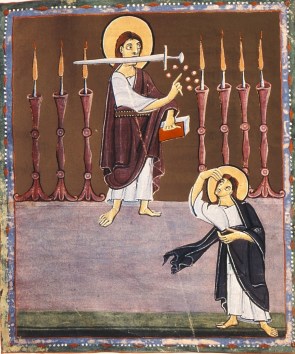
In the first chapter, John names the audience of his letter, but more importantly, he discloses the identity and nature of the one who is revealing the message to him. When God speaks to John, God reveals some key things about the fundamental nature of God – God is Alpha and Omega, first, and last, beginning, and the end. In other words, all of creation finds its ultimate existence, meaning, and purpose in God – what God began, God will complete. God is also named Almighty – the supreme ruler – the only one God’s people should serve. In these few words of Revelation 1:8, the recipient of this message hears these two major themes that are emphasized over and over again throughout Revelation: that God will bring to completion the work that he began, and that God is the only one worthy of allegiance.
John also gives us a vision of the exalted Jesus Christ – and here he doesn’t look like the gentle, pastoral Jesus we are used to seeing. Here, he is depicted as a blazing and brilliant vision – triumphant, and even a bit scary. He’s depicted as having a voice like rushing waters, with a sharp, double-edged sword coming from his mouth. The exalted Jesus proclaims that he lives and that he holds the keys of death. While the depiction of the exalted Christ is somewhat terrifying, John reveals to us that ultimately, Christ has conquered death and stands triumphant over it; therefore, Christians need not fear death because Christ frees them from the constraints of death. This triumphant Christ is an image of hope to faithful Christians who face the prospect of death at the hands of empire, and this Christ has a message he wants John to share with seven churches in Asia Minor.
 Chapters 2-3 consist of these specific messages to seven churches of Asia Minor. Each letter follows a basic pattern:
- Identification of the church being addressed
- Identification of the one sending the message
- Words of praise
- Admonitions/criticism
- An exhortation to faithfulness
- A promise to the one who remains faithful
Each letter addresses issues of cultural accommodation and faithfulness. Ultimately, each of the seven churches are presented with these questions: What does it mean to be in the world, but not of the world? How much compromise with non-Christian beliefs or practices is ok? What does faithfulness look like, and what is the cost? What distinguishes Christianity from the rest of the world?
While John directed these questions to a particular people in a particular time in place, these questions speak to us today as well. Mitchell G. Reddish says it well in his commentary on Revelation:
“Cultural accommodation is as much a danger in modern society as it was the in first century, perhaps even more so. Whereas John’s readers could readily perceive a difference between their beliefs and practices and those of the larger Roman society, modern culture (particularly in the United States) is often seen as being “Christian,” or at least sympathetic to Christianity. As such, the institutions and structures of society are viewed as “Christian” institutions and structures. Democracy and capitalism are viewed as biblical ideals. America itself becomes the new “promised land.” To fight for Western values and ideas is equated with fighting for Christian values. In such a setting, the danger of Christianity losing its “otherness” is very strong. The challenge for the church is to find a way to be a part of the society in which it lives without losing its otherness.”
These may be hard words for us to hear, especially when there are many wonderful things about being a part of the society in which we live. We enjoy many freedoms, and there are impulses within our society that I do believe align with the nature of God’s kingdom, which we see wherever we strive to care for the vulnerable, to lift up the forgotten, and to champion the oppressed. While I believe the best our society has to offer is rooted in the love of Christ, there is also much within today’s empire that seeks to squash out his kingdom. Just as Christians living under the Roman empire were forced to choose between faithfulness to God’s kingdom and bowing down to the values of the Roman empire, there are times, where, as Christians, we are forced to choose between faithfulness to the kingdom of God or bowing down to the values of today’s ruling powers, which in many cases are cloaked in the language of Christianity, but bear very little resemblance to the values of Jesus. In some ways, it was easier for these early Christians addressed in Revelation to see the distinctions between the values of empire and the values of God’s kingdom because the two were clearly separate entities. The waters became much murkier after Christianity became the official religion of the Roman empire a couple of centuries later, and the waters have been murky for us ever since. Ultimately, as the exalted Christ says in Revelation 1:6, the church is called to be a “kingdom of priests serving his God and Father.” In other words, the church is supposed to be distinct and set apart, with a call to remain faithful above all else. We’ll talk more specifically about these ideas in the next entry – for both the early church and for the church today – where we look at chapters 4-5 and the visions of the heavenly throne room.
Again, in these posts, we can’t dive as deeply as we are able to in the study, but I hope you will read chapters 1-3 and listen for these themes and ideas, and ponder them in your heart! May we each hear and discern God’s call to faithfulness and have the courage to heed that call.
Also, if you haven’t yet read the introductory blog post, you can find it here.

 This morning something TERRIBLE happened on my way to Bible study. There I was, driving along, and then all of a sudden, I saw these legs and this body slowly lowering itself down right in front of my face. A SPIDER. What nerve of this creature to drop down in front of me while driving! Who did he think he was? Thankfully, I was driving slowly on a side street at the time, because I proceeded to freak out, flailing my arms around, fidgeting in my seat, looking for the closest thing I could find to get the spider away from me. I proceeded to flick it onto the dashboard, and then grabbed a napkin from my glove compartment, and I squashed that sucker. I squashed him good. All of this happened within a few seconds. But as soon as I squashed the spider, this thought crept into my mind, unbidden: “Why did I have to go and kill it?”
 We cannot continue on the path of fast anger and loose tongues, unleashed to squash one another, but we still have time to choose to act differently toward one another and to embrace a posture of deep listening to those we do not understand; to those whom we fear. I too, am learning that I need to take James’ words to heart. All too often, I want to share the first thing that comes to my mind – I want to express disgust and moral outrage over so many things. I want to drown out those with whom I disagree. I want to squash their views and promote mine. But that gets us nowhere good. Today, may we all take these words to heart: let us be quick to listen, slow to speak and slow to become angry, and may we seek to listen to one another and see one another through the eyes of Jesus Christ.
 Collars With Sleeves