
From even before his birth, Darick and I have talked about intentionally making an effort to being committed to helping Gus understand and value diversity. We are attempting to live that out through making sure we have books where the main characters are of different genders and races, of different life experiences. We are attempting to live that out through our decisions about where he goes to daycare and who he has the opportunity to interact with. We want him to grow up knowing the value of all people, and I think we are off to a decent start.
However, one thing that is starting to hit home for me is that a commitment to Gus experiencing and valuing diversity is only a first step. Teaching him to value diversity or to be non-racist is not the same thing as teaching him how to be anti-racist. Jennifer Harvey writes,
“Nonracism is not the same thing as antiracism. It is important to combat stereotypes and biases. But in any context where racism and racial injustice already run rampant, nonracism isn’t enough to create equity or justice. In such a context, antiracism is required. A commitment to antiracism goes well beyond nonracism. It means actively countering and challenging racism.”
 I want my child to grow up seeing the value of all people, but even more, I want him to grow up to be a champion for all people. That means that we have the hard job of naming injustice where we see it, and teaching him to see it and name it as well, and all in age-appropriate ways, (no small task there!) ;-). It means that we, as his parents, have to have eyes to see the ways in which we participate in racist systems, and that we, ourselves, have to work to dismantle them. And that means giving up our own power and privilege (which is soooo much easier in theory than in reality). It isn’t enough to teach him not to be prejudiced – we have to teach him to work against the systems that institutionalize prejudice.
So what does that mean for where we are right now? I’m not entirely sure. I know that we will continue to expose him to a diversity of people. We will not teach him “not to notice” race as he begins to see and articulate differences. As Harvey writes, “The only way we show that we actually respect our shared humanity is by taking people’s specific, diverse experiences of their humanity very seriously.”
In other words, we don’t treat everyone as interchangeable objects, but rather we respect each specific individual and their lived experiences. To see race does not automatically mean using that difference to divide or set people up against one another. To see race (even though it is a human construction) is to see, rather than deny, the realities that black and brown people experience on a daily basis. To see race is not to perpetuate the inequalities, but to recognize the disparities and to name the injustices that are committed against those who are also created in God’s image. Harvey continues,
“We’ve got to do the same with our kids. If we want children who value everyone, and who deeply and authentically understand we’re all a part of a shared humanity, if we want them to actually live in ways that help to realize equity, the only route is to consciously and explicitly teach them about difference!”
All of this makes me really uncomfortable. I would much rather just expose my kid to a variety of people and teach him to be color-blind. In an ideal world where there is no injustice or racism, maybe that would be fine. But that is not the world we live in – in our current time, we are experiencing a resurgence of explicit racism. I am scared all the time about saying something wrong (and I’m even afraid that I’ve done that in this post!). But not saying anything and simply hoping for the best is not an option. If I want my child to be anti-racist and not just non-racist, then that means having bumbling and uncomfortable conversations and teaching uncomfortable things. But none of this is about my comfort. It is about God’s justice.
These are initial thoughts and challenges I am wrestling with as I read this book. I’m sure I’ll be wrestling more in future posts with ideas I’ve only mentioned or alluded to here (re: color-blindness, dealing with my own white guilt, fear of saying something wrong, etc). Please, wrestle with me.
– Cindy+
 As a pastor, a person of faith, and a human being, confronting my own privilege, prejudice, and participation in systemic racism is something that I have been wrestling with for a long time and will continue to wrestle with until the day I die. Now that Darick and I have added a tiny human into our family, it feels as though that hard work has become even more complex and challenging, as we are trying to figure out how to raise our son to be anti-racist and a champion of God’s justice in a world filled with injustice.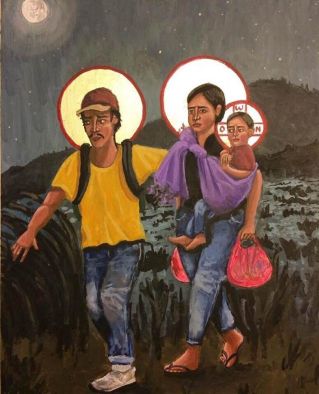
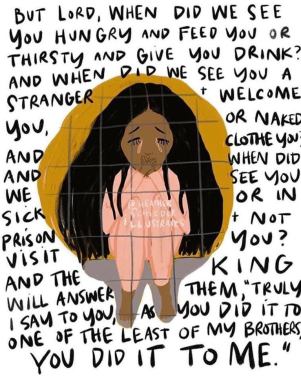 We know this is so when we barely blink an eye when the lives of those seeking to be free from violence are denied asylum in a country whose motto was once so proudly declared: “Give me your tired, your poor, Your huddled masses yearning to breathe free, the wretched refuse of your teeming shore…”
 Collars With Sleeves