What is Good?

Most people don’t set out to be the bad guy. Most people don’t commit acts of evil for the sake of evil. Throughout my college and graduate school years, as I studied philosopher-theologians like St. Augustine and Thomas Aquinas, they helped me begin to understand that we, as human beings, are all motivated by our own perceived good. In other words, everyone acts to their own benefit; to their own good. Even those whose actions we would say are the most vile, like those of the Third Reich, or the Khmer Rouge, or ISIS, did not perpetrate evil for the sake of evil – it was, instead, for what they perceived to be good – for the sake of self-preservation, for the sake of power to further the (righteous) cause of the nation/party/ideology, and to eliminate perceived threats to their way of life. And yet, we can look at the actions of these three examples and say in clear and certain terms that the acts they committed were atrocities – immoral, unethical, repugnant, evil.

st-augustine-of-hippo-icon-703See, that’s the thing about sin. That’s the thing about our sin. It blinds us. It distorts our understanding of true Good and instead replaces it with our own self-perceived good. St. Augustine defined sin as incurvatus in se, which means we are so curved in on ourselves that we see ourselves before anything else – before God, and before others. Our first instinct is to feed our own desires. This can manifest itself in many ways. It can manifest in the ways we often think of when we hear the word “sin.” It can be evident in the ways we (read: I) act in gluttonous ways, gorging myself on food that just tastes too good, even when I know it is detrimental to my health. It can be evident in dysfunctional sexual relationships. It can be evident in excessive drinking, in gossiping, in lying. But sin can also be evident in our desire for self-preservation. Sin can be evident when I erect boundaries around myself and what I consider to be mine.

A couple of years ago I watched a movie called “Conspiracy,” which dramatized the Wannsee Conference of 1942, where Third Reich officials came together to strategize on how to deal with the “Jewish problem” as put forth by Hitler. What made the movie so chilling was the way in which the men who were gathered discussed and strategized in such a business-like way over this “problem.” As they shared in refreshments and conversation, they moved closer and closer to the “final solution,” which was the wholesale extermination of the Jewish population. For the officers present and participating in this meeting, they believed that they were working for the betterment of Germany – for the preservation of the German people. They so strongly believed that they were working for what they saw as the good of their people and their country that they were able to completely dehumanize a whole people group. “Better to eliminate the threat and protect our own,” they said. History has told us of the atrocities that followed.

“Better to eliminate the threat and protect our own” is something we see repeated over and over in our society today. We see it when we categorize people as “us” and “them.” We see it in “America first,” in our policies around border crossing, in the backlash American Muslims have experienced, and in the way we systemically continue to treat people of color. Most people don’t set out to be the bad guy. Most people don’t commit acts of evil for the sake of evil. Most people act for their own benefit or protection. This makes sense in a world mirred in sin. But, for people who profess Jesus Christ as Lord and Savior, for those who call upon his name, repent of their sin, and entrust themselves to his transforming grace, there is no longer any excuse. If, for St. Augustine, sin is being curved in on one’s self, then salvation, freedom in Christ, is the process of becoming uncurved – of having our spine straightened out – so we no longer look first to our own desires and interests.

Now that I have a child, I understand better than I ever have about wanting to protect something with everything that I have. I understand better than ever the desire to build up a wall of protection around him so that nothing bad will happen to him. I understand better than ever the power of fear and what that could lead me to do in the name of protecting me and mine. But I also understand that “perfect love casts out fear” (1 John 4:18). As a Christian, I am called, through the power and grace of God, to grow in love – love of God and love of neighbor. As a Christian parent, I am also called to teach my son what this means, and that means showing him. That means welcoming the stranger, caring for the vulnerable, working for justice. It means putting aside my own self-interests, my own perceived goods, for the sake of the Good of God. It means offering compassion and mercy for those in need. It means foresaking worldly powers, refusing to worship worldly regimes, and recognizing that unjust laws are no laws at all.

Mister Rogers says it well: “We live in a world in which we need to share responsibility. It’s easy to say, ‘It’s not my child, not my community, not my world, not my problem.’ Then there are those who see the need and respond. I consider those people my heroes.”

fred rogers

The Christian story is one that shows us that God continually breaks down the boundaries that we erect. It shows us that the stranger, the outcast, the hurting, the least of these, are the ones who are brought from the edges into the center of God’s kingdom. The Christian story is one that shows us that love, not fear, is the most powerful force, and that Christ came not to be served or to claim power, but to serve and to give himself away for the sake of us, when we were still “other.” When we choose to follow Christ, the breaker of walls, we can no longer say, “It’s not my child, not my community, not my world, not my problem.” I pray that what I perceive as good will come into alignment with what God deems as Good. May we all see with the eyes of God, love with the heart of Jesus, and move with the power of the Holy Spirit.

– Cindy+

Understanding Revelation: Only One is Worthy (Chapters 4-5)

Wilfrid J. Harrington writes, “The great throne dominates Revelation: a constant reminder that God rules even in our chaotic world.” As we move into chapters 4-5 of Revelation, the setting of John’s vision shifts to this “great throne”. In Jewish and Christian apocalyptic literature, revelationThe Heavenly Throne Room.jpgs are mediated to the human recipient in two ways: in the form of dreams/visions, and in the form of other worldly journeys. Chapters 1-3 of Revelation fall under this first type, while chapters 4-5 shift to something more similar to the second type where John is called up and shown a heavenly throne room. As John’s vision takes him to the heavenly throne room, he, and we, find this central theme in the text – that God alone is worthy to receive the believer’s total allegiance.
Again, as we explore the imagery of these chapters, remember that John is not attempting to present a blueprint for the future or a road map for the end of the world. His approach is not logical or sequential, but creative. His visions are variations on a few related themes. Revelation is a book we are meant to creatively experience, rather than to dissect line by line.

We find a number of symbols present in the throne room imagery, which communicate to us some truths about what it means to worship God and God alone. The following are some of the notes I shared during the Bible study:

Rainbow – reminds us of God’s covenant with Noah; a sign of God’s mercy that tells us there is to be no triumph for God’s sovereignty at the expense of his mercy

24 Elders – The identity of the 24 is not entirely clear – a common interpretation is the 12 tribes of Israel + the 12 disciples; another is a doubling of the 12 tribes of Israel, thus representing both Jewish and Gentile believers, ie. The totality of the Church. They are heavenly exemplars of pure worship of God, in contrast with worship of the emperor that is occurring on earth

Thunder and Lightning – conventional imagery used for theophanies (appearances or manifestations of God) in the Old Testament

Seven Blazing Lamps – similar to the 7-branched menorah in the Jerusalem temple; John says they represent the seven spirits of God – affirming the wholeness of God’s presence and work

Sea of Glass – ancient Hebrew cosmology (understanding of the world/universe) conceived waters as below the earth and above the firmament (the dome covering the earth), and water was seen as a representation of chaos, evil, and the untamed part of creation. Here, the sea is made calm under God’s rule and presence

4 Living Creatures – modified from imagery in Ezekiel 10; representations of the highest order of angels who stand closest to the throne of God; cherubim and seraphim are described as the highest orders of angels in the Old Testament, and they are usually depicted as winged creatures that have characteristics of both animals and humans

Scroll with 7 Seals – legal documents were often written on one side of a scroll, then folded, sewn together, and sealed, with a summary of the content written on the outside – this scroll could represent the kingdom of God that is conveyed by the work of the Lamb; it could also represent the purposes/plans of God for all of creation, which are effected through Jesus; seals were used not only to safeguard a document, but they also identified the source of the document – the only one who can open the scroll is the Lamb

Lion or Lamb? – Jesus is originally described as the Lion of Judah – an image of a fierce and conquering ruler. John looks around for this Lion, but instead of a lion he finds a lamb with the marks of its slaughter. “Lamb” is the most prominent title for Christ in Revelation, appearing 28 times

Lamb’s 7 Horns – symbols of power and strength

Lamb’s 7 Eyes – symbols of God’s presence and knowledge, demonstrating that the Lamb acts with the authority of God

At the center of these two chapters (and really the whole of Revelation) is a question about worship. Who do we worship? To whom do we give our allegiance? The Christians who lived during the time of the writing of Revelation were faced with some difficult decisions to make about how they chose to live, especially in relationship to the Roman empire.

The Roman empire was incredibly powerful – the emperor held ultimate authority over the empire, and he knew it. Roman emperors had even taken to claiming divine status, and demanded that Roman citizens worship him as a divine being. Christians were faced with this difficult choice: refuse to participate in the imperial cult of emperor worship and likely face some form of persecution, or go through the outward actions of participating in the imperial cult, even if they believed differently in their hearts, and avoid persecution. For John, the choice was clear. Faithful Christians can do nothing other than worship the one true God. To do anything other was a complete denial of faith.

Chapters 4-5 center around the absolute worship of God. The heavenly throne room is centered wholly around God, who is in the center. The attention of all of the creatures and elders is focused solely on the one whom they worship. There is no room for anything else. Worship, in Revelation, is a political act. Through worship, one declares one’s own allegiance and loyalty. Through worship, one reaffirms again and again that commitment. Those who worship God cannot give allegiance to Rome or its emperor.

Furthermore, chapter 5 gives us a picture of the character of this God that we are called to give our whole allegiance to. We find that the one who is worthy to open the scroll is the one on the throne – and the one John finds on the throne is the Lamb who was slain.

Lamb
Lamb of God, 6th C in dome of Basilica of San Vitale in Ravenna 

This was a surprise for John, because he was expecting to see a fierce, conquering Lion, the Lion of Judah. But instead he finds the Lamb, bearing the marks of execution. As Mitchell G. Reddish points out, “Through this imagery, John declares that the only ‘conquering’ that is consistent with the values of God is conquering that occurs through self-sacrifice and love, not through violence.” At the center of Christian worship is a ruler who does not claim authority through violence or force, but through the giving of self for the sake of the other. This is fundamentally contrary to the ways that the kingdoms of the world, like Rome, work.

As the scene in the heavenly throne room continues to unfurl, we see who else is participating in the act of worshipping the Lamb – it has moved from just the creatures and the elders to include tens and thousands, and they sing a song of praise and honor, recognizing that people from every tribe, language, people, and nation are included in this new reality. There are no barriers; there are no divisions. The Lamb has broken all of those down.

We have much to ponder from these two chapters. They raise many questions for Christians today, living in America. To whom or what are we ultimately giving our allegiance? Where have the lines between worship of God and worship of empire been blurred?  How do we tell the difference, and how are we called to live faithfully in such a time and place? Read the two chapters again, and reflect on these questions. I’ll leave you with another word from Mitchell G. Reddish for you to ponder, a word which may or may not sit well with you. Whether it rubs you the wrong way, or whether it resonates with what you experience, take some time to pray and ask God to reveal what it is to be faithful to the Lamb today.

“American culture lays claim to the allegiance of the church. Patriotism becomes entwined with religious faith. American flags are placed in churches; churches hold patriotic rallies. Capitalism is seen as a divinely ordained economic system. Caesar demands to be worshiped, and too readily the church obeys. As a result, the message of the gospel is subverted, and the church becomes a willing participant in the deification of nationalism. To this situation, also, the book of Revelation declares, “You must not do that. Worship God!”

You can read the introduction here and the blog on chapters 1-3 here.

Understanding Revelation: A Call to Faithfulness (Chapters 1-3)

St. Augustine wrote, “Now in this book called the Apocalypse there are, to be sure, many obscure statements, designed to exercise the mind.” And so we begin our exploration into the many obscure statements of Revelation that will do more than exercise our minds. Revelation is a book that at times stretches us, at other times confounds us, but always speaks hope into our lives and leads us on a journey pursuing faithfulness to the Kingdom of God.

As Revelation begins, the text highlights two ideas – that John clearly understands his visions as something revealed by God, and that God intends for John to take on the prophetic duty of delivering that message. These days, prophecy is often understood primarily, or at times, exclusively, as foretellings or predictions of the future, and therefore, a prophet is seen as someone who predicts the future. While speaking of future events can certainly be an aspect of the prophetic task, a prophet is someone who is tasked with delivering God’s message to a particular people in a particular time and place. John understood his message to be directed towards the Christians of Asia Minor (modern-day Turkey) during the first century – and John clearly states in chapter 1 that he is not speaking of some distant time in the future, but of a time in the near future when the suffering and persecution of the Christians of Asia minor would come to an end. Keeping in mind John’s prophetic task to convey God’s message to a particular persecuted people can help us in understanding the purpose of Revelation – and accordingly, how we, as 21st century Christians in America, can responsibly read and interpret John’s words for today.

Jesus and Seven Lampstands
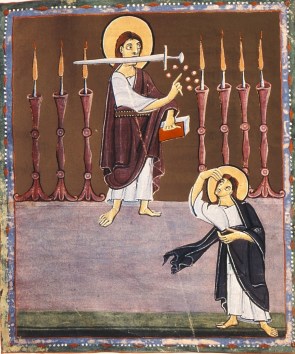
Illustration from the Bamberg Apocalypse of the Son of Man among the seven lampstands.

In the first chapter, John names the audience of his letter, but more importantly, he discloses the identity and nature of the one who is revealing the message to him. When God speaks to John, God reveals some key things about the fundamental nature of God – God is Alpha and Omega, first, and last, beginning, and the end. In other words, all of creation finds its ultimate existence, meaning, and purpose in God – what God began, God will complete. God is also named Almighty – the supreme ruler – the only one God’s people should serve. In these few words of Revelation 1:8, the recipient of this message hears these two major themes that are emphasized over and over again throughout Revelation: that God will bring to completion the work that he began, and that God is the only one worthy of allegiance.

John also gives us a vision of the exalted Jesus Christ – and here he doesn’t look like the gentle, pastoral Jesus we are used to seeing. Here, he is depicted as a blazing and brilliant vision – triumphant, and even a bit scary. He’s depicted as having a voice like rushing waters, with a sharp, double-edged sword coming from his mouth. The exalted Jesus proclaims that he lives and that he holds the keys of death. While the depiction of the exalted Christ is somewhat terrifying, John reveals to us that ultimately, Christ has conquered death and stands triumphant over it; therefore, Christians need not fear death because Christ frees them from the constraints of death. This triumphant Christ is an image of hope to faithful Christians who face the prospect of death at the hands of empire, and this Christ has a message he wants John to share with seven churches in Asia Minor.

Seven Churches MapChapters 2-3 consist of these specific messages to seven churches of Asia Minor. Each letter follows a basic pattern:

  1. Identification of the church being addressed
  2. Identification of the one sending the message
  3. Words of praise
  4. Admonitions/criticism
  5. An exhortation to faithfulness
  6. A promise to the one who remains faithful

Each letter addresses issues of cultural accommodation and faithfulness. Ultimately, each of the seven churches are presented with these questions: What does it mean to be in the world, but not of the world? How much compromise with non-Christian beliefs or practices is ok? What does faithfulness look like, and what is the cost? What distinguishes Christianity from the rest of the world?

While John directed these questions to a particular people in a particular time in place, these questions speak to us today as well. Mitchell G. Reddish says it well in his commentary on Revelation:

“Cultural accommodation is as much a danger in modern society as it was the in first century, perhaps even more so. Whereas John’s readers could readily perceive a difference between their beliefs and practices and those of the larger Roman society, modern culture (particularly in the United States) is often seen as being “Christian,” or at least sympathetic to Christianity. As such, the institutions and structures of society are viewed as “Christian” institutions and structures. Democracy and capitalism are viewed as biblical ideals. America itself becomes the new “promised land.” To fight for Western values and ideas is equated with fighting for Christian values. In such a setting, the danger of Christianity losing its “otherness” is very strong. The challenge for the church is to find a way to be a part of the society in which it lives without losing its otherness.”

These may be hard words for us to hear, especially when there are many wonderful things about being a part of the society in which we live. We enjoy many freedoms, and there are impulses within our society that I do believe align with the nature of God’s kingdom, which we see wherever we strive to care for the vulnerable, to lift up the forgotten, and to champion the oppressed. While I believe the best our society has to offer is rooted in the love of Christ, there is also much within today’s empire that seeks to squash out his kingdom. Just as Christians living under the Roman empire were forced to choose between faithfulness to God’s kingdom and bowing down to the values of the Roman empire, there are times, where, as Christians, we are forced to choose between faithfulness to the kingdom of God or bowing down to the values of today’s ruling powers, which in many cases are cloaked in the language of Christianity, but bear very little resemblance to the values of Jesus. In some ways, it was easier for these early Christians addressed in Revelation to see the distinctions between the values of empire and the values of God’s kingdom because the two were clearly separate entities. The waters became much murkier after Christianity became the official religion of the Roman empire a couple of centuries later, and the waters have been murky for us ever since. Ultimately, as the exalted Christ says in Revelation 1:6, the church is called to be a “kingdom of priests serving his God and Father.” In other words, the church is supposed to be distinct and set apart, with a call to remain faithful above all else. We’ll talk more specifically about these ideas in the next entry – for both the early church and for the church today – where we look at chapters 4-5 and the visions of the heavenly throne room.

Again, in these posts, we can’t dive as deeply as we are able to in the study, but I hope you will read chapters 1-3 and listen for these themes and ideas, and ponder them in your heart! May we each hear and discern God’s call to faithfulness and have the courage to heed that call.

Also, if you haven’t yet read the introductory blog post, you can find it here.