The Reflectionary – Week of January 5, 2020

Epiphany 1

Text: Mark 2:1-22

A few days later, when Jesus again entered Capernaum, the people heard that he had come home. They gathered in such large numbers that there was no room left, not even outside the door, and he preached the word to them. Some men came, bringing to him a paralyzed man, carried by four of them. Since they could not get him to Jesus because of the crowd, they made an opening in the roof above Jesus by digging through it and then lowered the mat the man was lying on. When Jesus saw their faith, he said to the paralyzed man, “Son, your sins are forgiven.”

 Now some teachers of the law were sitting there, thinking to themselves, “Why does this fellow talk like that? He’s blaspheming! Who can forgive sins but God alone?” 

Immediately Jesus knew in his spirit that this was what they were thinking in their hearts, and he said to them, “Why are you thinking these things? Which is easier: to say to this paralyzed man, ‘Your sins are forgiven,’ or to say, ‘Get up, take your mat and walk’? But I want you to know that the Son of Man has authority on earth to forgive sins.” So he said to the man, “I tell you, get up, take your mat and go home.” He got up, took his mat and walked out in full view of them all. This amazed everyone and they praised God, saying, “We have never seen anything like this!”

Once again Jesus went out beside the lake. A large crowd came to him, and he began to teach them. As he walked along, he saw Levi son of Alphaeus sitting at the tax collector’s booth. “Follow me,” Jesus told him, and Levi got up and followed him.
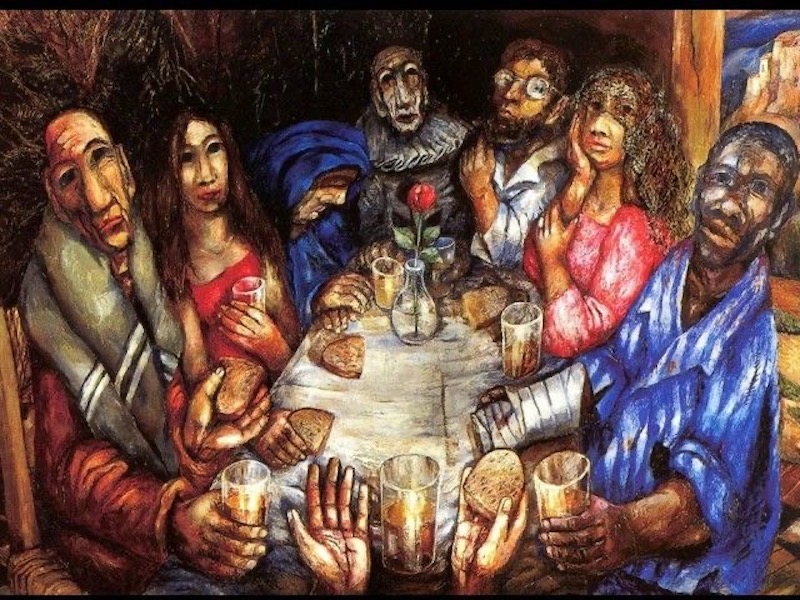
Painting by Fr. Sieger Koder

While Jesus was having dinner at Levi’s house, many tax collectors and sinners were eating with him and his disciples, for there were many who followed him. When the teachers of the law who were Pharisees saw him eating with the sinners and tax collectors, they asked his disciples: “Why does he eat with tax collectors and sinners?” 

On hearing this, Jesus said to them, “It is not the healthy who need a doctor, but the sick. I have not come to call the righteous, but sinners.”

Now John’s disciples and the Pharisees were fasting. Some people came and asked Jesus, “How is it that John’s disciples and the disciples of the Pharisees are fasting, but yours are not?” 

Jesus answered, “How can the guests of the bridegroom fast while he is with them? They cannot, so long as they have him with them. But the time will come when the bridegroom will be taken from them, and on that day they will fast. 

“No one sews a patch of unshrunk cloth on an old garment. Otherwise, the new piece will pull away from the old, making the tear worse. And no one pours new wine into old wineskins. Otherwise, the wine will burst the skins, and both the wine and the wineskins will be ruined. No, they pour new wine into new wineskins.”

Reflection

In this week’s text, we find Jesus in three different scenes: one healing a man who is paralyzed, one sitting at Levi’s dinner table, and one where Jesus is questioned as to why he is not fasting when everyone else is. If I had to name this passage like an episode of the show Friends, I’d call it, “The One Where Jesus Flips Expectations.”

The first story begins with a familiar scene – many gathered around Jesus as he teaches in a home. People have come from all around town and the surrounding countryside to learn from this teacher and healer. It’s no surprise that people are clamoring to get close to Jesus to experience his miraculous healing for themselves. That’s exactly what four men do when they bring a paralyzed man to Jesus. But it’s so crowded they can’t even get in the house. So they do the best thing they can think of – they climb up onto the roof, pull away some of the thatching, and they lower their friend down from the roof to the space right in front of Jesus. Their persistence and faith are certainly central aspects of this story. In this moment though, I want to consider the surprising way that Jesus responds.

Expectations were such that Jesus would, of course, immediately heal this man of his paralysis. Instead, Jesus responds in an unexpected way. He says, “Son, your sins are forgiven.” Jesus, say what? Your sins are forgiven? First of all, that wasn’t even what they were asking for. Second of all, how can Jesus even do that? Isn’t God the only one able to forgive sin? (Which, of course, is the whole point of Jesus doing such a thing – to reveal that he’s more than just a healer; he was, in fact, God in the flesh.) Receiving forgiveness of sin was not what anyone was expecting from Jesus. The boundaries between God and humanity were being torn down in this encounter, and those who questioned Jesus on this knew it.

The second scene, too, flips expectations in their head. Jesus is sitting down to dinner with a number of people. That part is not surprising. But where is Jesus eating? He’s eating at Levi’s house. A tax collector. A tax collector was someone who was seen as a corrupt extortionist. A Jewish tax collector was those things and more – he was a betrayer of his people by working for Rome, the empire of oppression. Jesus is eating in such a man’s house, along with other sinners. The Pharisees ask themselves, “what in the world is Jesus doing? How could he eat with such unrighteous people?” As they voice their question, Jesus responds, “It’s not the healthy people who need a doctor, but the sick.” Again, not what they were expecting from Jesus.

And then there’s the third scene, which is little more than Jesus giving a semi-cryptic response to a few people who came to ask him why he and his disciples were not fasting when both John and the Pharisees were. He talks about a present bridegroom, unshrunk cloth, and wineskins, and in each metaphor, Jesus seems to be telling his listeners that he is doing something different. He’s breaking from the norm. Something new is taking place.

In this single chapter of Mark’s gospel, Jesus is clearly different than what many expected him to be. They don’t yet truly understand, but Jesus is beginning to show them that he is one to flip expectations. And isn’t that what God does? Any time we try to put God in our own box or conform him to our image, God breaks out and says, nope, that’s not who I am – let me show you a little bit more.

It can be jarring when our picture of God is stretched, or when our understanding of how we practice faith is challenged. Those who were around Jesus struggled to understand what he was doing and saying. The Pharisees and many other devout people really did not know how to handle Jesus. While there were, certainly, some Pharisees who were hypocritical, judgmental, or power-hungry, on the whole, I think they were largely a group of pious people who were doing their best to be faithful in keeping the covenant with God. And yet, Jesus challenges them. Jesus challenges us today too. Jesus challenges pious Christians who are just doing our best to be faithful in keeping the covenant with God.

If this gospel text reminds us of anything, it is this: Jesus will constantly surprise us and challenge our expectations of him. Are you willing to encounter him in new and unexpected ways?

Ponder

o   What words, phrases, or images from the text speak to you? What thoughts or feelings do they evoke?
o   How has Jesus surprised you?
o   Where have you been stretched in your faith?

Challenge

Jesus had a habit of going and hanging out with people who were different or excluded. He challenged categories left and right. Consider a group of people who might be different than you. What might you be able to do to bring yourself into a closer relationship with them? Perhaps it could mean going and sitting down to share a meal with someone at Manna Meal in downtown Charleston or volunteering with a recovery home. Maybe you could ask to visit with folks from our local mosque or from the synagogue or temple downtown. (And if you need help in making connection with any of those communities, please let Pastor Cindy know)

And/or

Jesus likes to sit down at the table with people. It is one of the main ways that he builds relationships with others in the New Testament. Make a plan to have a meal with someone – a coworker, a neighbor, someone you may not normally get to spend much time with. Have them over for dinner, or go out to eat together.

Prayer

God, you always flip my expectations. You show up in places I’m not expecting or looking. Help me to see you wherever you are and to also see whomever you are with. Do something new within me, that I might be a new wineskin, ready to receive your transforming grace. In Jesus’ name I pray, Amen.

-Cindy+
The Reflectionary – Week of December 15, 2019

Advent 4

Text: Luke 1:5-24; 57-80

In the time of Herod king of Judea there was a priest named Zechariah, who belonged to the priestly division of Abijah; his wife Elizabeth was also a descendant of Aaron. Both of them were righteous in the sight of God, observing all the Lord’s commands and decrees blamelessly. But they were childless because Elizabeth was not able to conceive, and they were both very old.

Once when Zechariah’s division was on duty and he was serving as priest before God, he was chosen by lot, according to the custom of the priesthood, to go into the temple of the Lord and burn incense. And when the time for the burning of incense came, all the assembled worshipers were praying outside. 

Then an angel of the Lord appeared to him, standing at the right side of the altar of incense. When Zechariah saw him, he was startled and was gripped with fear. But the angel said to him: “Do not be afraid, Zechariah; your prayer has been heard. Your wife Elizabeth will bear you a son, and you are to call him John. He will be a joy and delight to you, and many will rejoice because of his birth, for he will be great in the sight of the Lord. He is never to take wine or other fermented drink,and he will be filled with the Holy Spirit even before he is born. He will bring back many of the people of Israel to the Lord their God. And he will go on before the Lord, in the spirit and power of Elijah, to turn the hearts of the parents to their children and the disobedient to the wisdom of the righteous—to make ready a people prepared for the Lord.”

Zechariah asked the angel, “How can I be sure of this? I am an old man and my wife is well along in years.” 

The angel said to him, “I am Gabriel. I stand in the presence of God, and I have been sent to speak to you and to tell you this good news. And now you will be silent and not able to speak until the day this happens, because you did not believe my words, which will come true at their appointed time.”

Meanwhile, the people were waiting for Zechariah and wondering why he stayed so long in the temple. When he came out, he could not speak to them. They realized he had seen a vision in the temple, for he kept making signs to them but remained unable to speak.

When his time of service was completed, he returned home. After this his wife Elizabeth became pregnant and for five months remained in seclusion.

 —————————-

When it was time for Elizabeth to have her baby, she gave birth to a son. Her neighbors and relatives heard that the Lord had shown her great mercy, and they shared her joy.

On the eighth day they came to circumcise the child, and they were going to name him after his father Zechariah, but his mother spoke up and said, “No! He is to be called John.”

They said to her, “There is no one among your relatives who has that name.”

Then they made signs to his father, to find out what he would like to name the child. He asked for a writing tablet, and to everyone’s astonishment he wrote, “His name is John.” Immediately his mouth was opened and his tongue set free, and he began to speak, praising God. All the neighbors were filled with awe, and throughout the hill country of Judea people were talking about all these things. Everyone who heard this wondered about it, asking, “What then is this child going to be?” For the Lord’s hand was with him.

His father Zechariah was filled with the Holy Spirit and prophesied:

“Praise be to the Lord, the God of Israel,
because he has come to his people and redeemed them.
He has raised up a horn of salvation for us
in the house of his servant David
(as he said through his holy prophets of long ago),
salvation from our enemies
and from the hand of all who hate us—
to show mercy to our ancestors
and to remember his holy covenant,
the oath he swore to our father Abraham:
to rescue us from the hand of our enemies,
and to enable us to serve him without fear
in holiness and righteousness before him all our days.

And you, my child, will be called a prophet of the Most High;
for you will go on before the Lord to prepare the way for him,
to give his people the knowledge of salvation
through the forgiveness of their sins,
because of the tender mercy of our God,
by which the rising sun will come to us from heaven
to shine on those living in darkness
and in the shadow of death,
to guide our feet into the path of peace.”

And the child grew and became strong in spirit; and he lived in the wilderness until he appeared publicly to Israel.

Reflection

When we found out I was pregnant, one of the first things we did was to choose potential names for our child. We agreed on a boy’s name and a girl’s name – each chosen with significance and intention. When our child was born and we saw that we’d had a boy, we joyfully named him Augustine Thomas, after St. Augustine and Doubting Thomas/Thomas Aquinas. Each of these people have had significant influence on our faith journeys, and so we gave our son those names, with the hope that he will go on his own faith journey.

Names are important in Scripture. They often tell us more about what is going on in a narrative. In today’s text, we meet two such people whose names reveal much: Zechariah and Elizabeth. We learn that Zechariah and Elizabeth are up there in years, and that they have been childless all this time. Of course, when we hear about an elderly, infertile couple in Scripture, we know that the unexpected is about to ensue! It’s no different here. Zechariah and Elizabeth are about to get the surprise of a lifetime – they will conceive and bear a child – the child who will grow up to be John the Baptist.

We know this story – but what do their names reveal? In her book, Light of the World: A Beginner’s Guide to Advent (which, incidentally is the book we are using for this year’s Advent study), Dr. Amy-Jill Levine tells us that the name Zechariah comes from the Hebrew root z-k-r,  which means “remember” and the yah” sound at the end of his name is the traditional marker for YHWH, the Divine Name. With this knowledge, we learn that Zechariah’s name literally means, “God remembers.”

Memory is a consistent theme throughout the Bible. Not only does God remember God’s people time and again, but God also calls God’s people to remember. In fact, memory is often tied to recognizing God’s miraculous and liberating work in the life of God’s people. God constantly calls God’s people to remember the covenant, to remember how God brought the people out of slavery in Egypt. God constantly calls God’s people to remember how God has been present, how God has spoken, how God has loved, and how God has delivered God’s people. Zechariah is one whom God remembers, just as he is also called to remember how God has worked throughout the life of the people of Israel.

And yet, we find that Zechariah seems to temporarily forget when the angel comes upon him in the Temple. He forgets the ways God has worked in the past, so he is unable to see how God is working in the present. He questions what the angel is saying, in disbelief. He loses his ability to speak as his memory of what God has done and can do fails him. It isn’t until his son is born that he is able to speak again. And what are the first words out of his mouth? A song remembering the way God has always remembered his people! Zechariah is now able to see the way God’s memory gets played out in his own present – he sees the relationship between memory and seeing the miraculous!

Elizabeth, too, is a name that echoes this theme of memory. According to Dr. Levine, her name likely derives from the Hebrew Eli, which means “my God,” and sheva, which means “oath.” Her name means “God’s oath” or “God keeps promises.” In other words, Elizabeth’s name reveals that God remembers what God has promised. God does not forget, and God follows through.

The whole of this first chapter of Luke’s gospel is one that proclaims that God remembers God’s people. God does not abandon, forget, or destroy them. God’s memory is long. And what does God remember? Love. God remembers God’s love for his people and he makes a way for them. The story of the birth of John the Baptist is a way that God begins to bridge the past into the present reality of the coming of Jesus Christ.

Like Zechariah, Elizabeth, and all of God’s people, we are called to memory, that we might recognize the miraculous. May we remember, even as God continually remembers us.

Ponder

o   What words, phrases, or images from the text speak to you? What thoughts or feelings do they evoke?
o   What stories of Scripture stick out in your memory? What stories have spoken to you?
o   Where in your own life do you recall experiencing God’s presence and grace?

Challenge

If you have been in the practice of journaling or writing prayers and you have access to older journals, go back and read through some of them. You may be surprised at moments they call to mind in your own spiritual journey.

And/or

Write a psalm of praise to God, recalling what God has done and is doing in your life.

Prayer

God, your memory is long. You never forget me. You never forget all of your people. Help me to recall the ways that you have worked in the lives of those who have gone before me, and in my own life, so that I might be able to see how you are working in the present. In Jesus’ name I pray. Amen.

-Cindy+

The Reflectionary – Week of December 8, 2019

Advent 3

Text: Ezra 1:1-4, 3:1-4, 10-13

In the first year of Cyrus king of Persia, in order to fulfill the word of the Lord spoken by Jeremiah, the Lord moved the heart of Cyrus king of Persia to make a proclamation throughout his realm and also to put it in writing:

“This is what Cyrus king of Persia says: 

“‘The Lord, the God of heaven, has given me all the kingdoms of the earth and he has appointed me to build a temple for him at Jerusalem in Judah. Any of his people among you may go up to Jerusalem in Judah and build the temple of the Lord, the God of Israel, the God who is in Jerusalem, and may their God be with them. And in any locality where survivors may now be living, the people are to provide them with silver and gold, with goods and livestock, and with freewill offerings for the temple of God in Jerusalem.’” 

———————-

When the seventh month came and the Israelites had settled in their towns, the people assembled together as one in Jerusalem. Then Joshua son of Jozadak and his fellow priests and Zerubbabel son of Shealtiel and his associates began to build the altar of the God of Israel to sacrifice burnt offerings on it, in accordance with what is written in the Law of Moses the man of God. Despite their fear of the peoples around them, they built the altar on its foundation and sacrificed burnt offerings on it to the Lord, both the morning and evening sacrifices. Then in accordance with what is written, they celebrated the Festival of Tabernacles with the required number of burnt offerings prescribed for each day.

———————-

When the builders laid the foundation of the temple of the Lord, the priests in their vestments and with trumpets, and the Levites (the sons of Asaph) with cymbals, took their places to praise the Lord, as prescribed by David king of Israel. With praise and thanksgiving they sang to the Lord: 

“He is good;
his love toward Israel endures forever.”
 

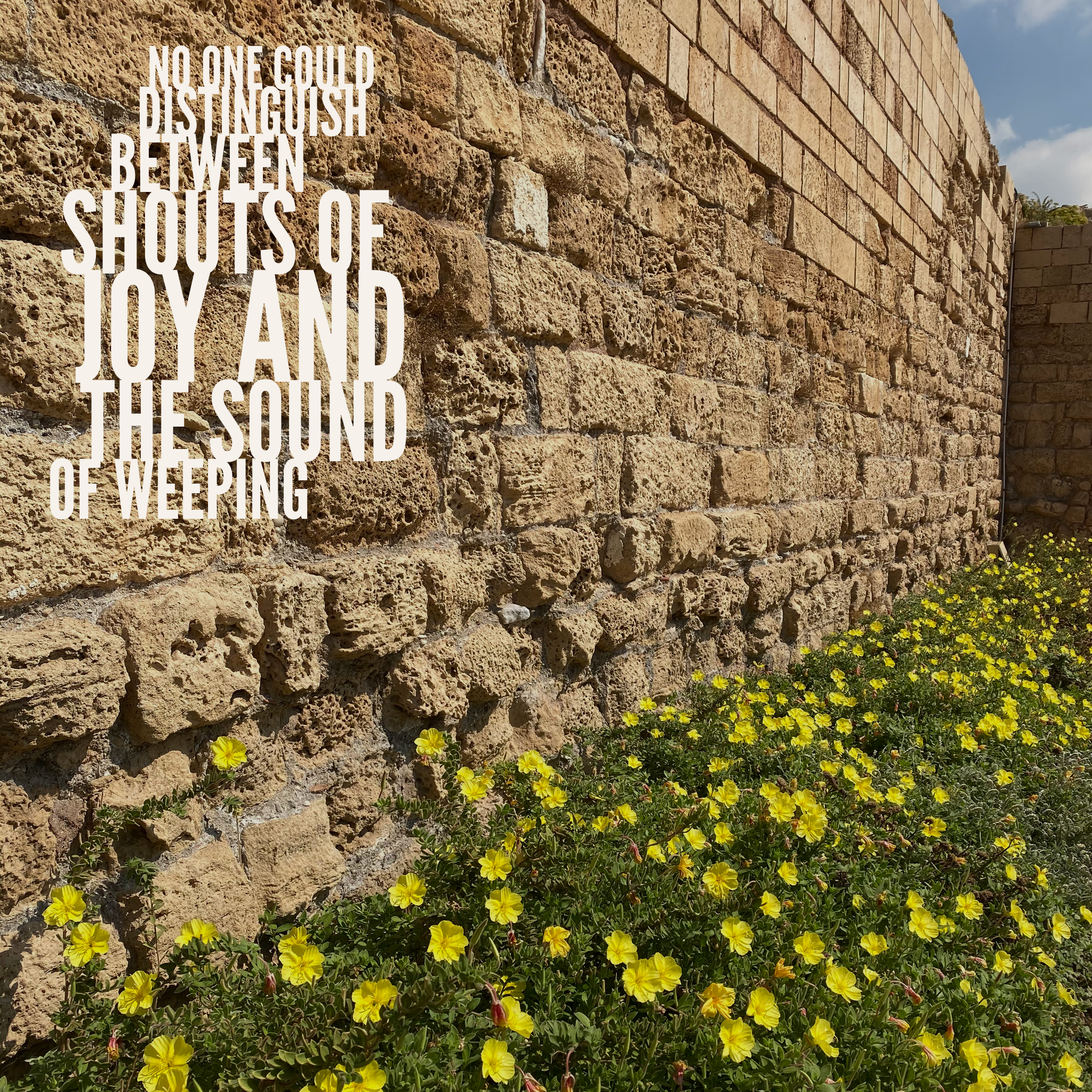
And all the people gave a great shout of praise to the Lord, because the foundation of the house of the Lord was laid. But many of the older priests and Levites and family heads, who had seen the former temple, wept aloud when they saw the foundation of this temple being laid, while many others shouted for joy. No one could distinguish the sound of the shouts of joy from the sound of weeping, because the people made so much noise. And the sound was heard far away.

Reflection

When I think back on Advent and Christmas as a child, I remember a sense of magic to it. I get this deep sense of sentimental nostalgia, where I wish I could relive this season now just as I remember experiencing it as a child. But no matter how I try, there is no going back. For me, that day has passed (though I now find joy in the season in different ways.)

I imagine that you, also, have experienced something like this. It might not be about Christmas, but perhaps it is about a time gone by. Maybe you look back to a time in your life when you were young, or your children were young. Maybe it was a time when everything in your life just felt so right. Maybe you look back to a time when the church was full, or when everyone knew their neighbors. Maybe you look longingly back at the time when you could let your children play outside without having to supervise them and you could leave your doors unlocked. We look back, and we long for those days, but no matter how we try, there is no going back.

In this passage from Ezra, we see some of the older priests, Levites, and family heads who experience this deep longing and grief for what once was. As we have been reminded in texts from previous weeks, the exile that the Kingdom of Judah experienced under Babylon was incredibly significant and disruptive to the life of the people of Israel. Though the exile was not particularly long, it challenged the people in major ways. The Temple built by King Solomon had been destroyed. Many people had been taken from the land. They had to figure out what it meant to worship God away from Jerusalem and without a Temple. It was HARD.

But now, the Persian king, Cyrus, had allowed the exiled people of Israel to return home. He allowed them to rebuild the Temple. For many, it was, in fact, a time of celebration. Rebuilding the Temple was a fulfillment of God’s promises. So why wasn’t everyone rejoicing?

For those who remembered the days of the first Temple, this new Temple paled in comparison. The first temple was built under the powerful and autonomous Kingdom of Israel. It was built with the great wealth of Solomon. It was the Temple of the “Golden Age.” This new Temple was built only under the auspices of the Persian king. It was built with much more meager resources. It could not compare to the Temple of days gone by. And so, the elders grieved. They had lived long enough to remember what once was, and they longed for it. They wept because they know no matter how hard they tried, there was no going back.

While we can relate to this passage as individuals, I think we can also relate to this passage as the Church. There is a general sense among those who have been Christian for a long time that we have long left behind the “Golden Age” of the church in America. Among many, perhaps yourself included, looking to the future does not bring about shouts of joy or a sense of excitement, but instead deep lament over what has been lost or left behind.

Moving into the future can be scary. It can be overwhelming. Change always brings some kind of loss. While the rebuilding of the Temple was certainly a time for celebration for many as God’s promises were being lived out in a new way, it was also a time of grief for others. This passage speaks to a new beginning and a new expression of the shared life of the people of Israel, but shouts of praise could not be distinguished from the sound of weeping. The sound and the deep emotions behind both are to be honored.

So know this today: if you are excited and thankful for new expressions of Church that are taking place in our midst, you are heard. But also know, if you are weeping and longing for what once was, you also are heard. And in it all, God is with you.

Ponder

o   What words, phrases, or images from the text speak to you? What thoughts or feelings do they evoke?
o   Where do you look back longingly in your own life?
o   Where do you look with excitement or anticipation of the future?

Challenge

Identify a change that has taken place in your life where you are now grieving the loss that has come through that change. Name it. Validate it.

And/or

It’s easy to get caught up thinking about days gone by. Sit down and make a list of things that you are grateful for in the present, and things you are hopeful for in the future. Give thanks to God for them all.

Prayer

Lord God, you are the giver of hope and new life. You constantly bring about the new and the good in me and in the world around me. I give you thanks for what you have done in the past, and I ask you now to help me look to the present and the future, and to find hope even in the midst of loss and change. In Jesus’ name I pray. Amen.

-Cindy+