The Reflectionary – Week of November 10, 2019

Text: Isaiah 5:1-7; 11:1-5

I will sing for the one I love
a song about his vineyard:
My loved one had a vineyard
on a fertile hillside.
He dug it up and cleared it of stones
and planted it with the choicest vines.
He built a watchtower in it
and cut out a winepress as well.
Then he looked for a crop of good grapes,
but it yielded only bad fruit.

“Now you dwellers in Jerusalem and people of Judah,
judge between me and my vineyard.
What more could have been done for my vineyard
than I have done for it?
When I looked for good grapes,
why did it yield only bad?
Now I will tell you
what I am going to do to my vineyard:
I will take away its hedge,
and it will be destroyed;
I will break down its wall,
and it will be trampled.
I will make it a wasteland,
neither pruned nor cultivated,
and briers and thorns will grow there.
I will command the clouds
not to rain on it.”

The vineyard of the Lord Almighty
is the nation of Israel,
and the people of Judah
are the vines he delighted in.
And he looked for justice, but saw bloodshed;
for righteousness, but heard cries of distress.

_______________________________

A shoot will come up from the stump of Jesse;
from his roots a Branch will bear fruit.
The Spirit of the Lord will rest on him—
the Spirit of wisdom and of understanding,
the Spirit of counsel and of might,
the Spirit of the knowledge and fear of the Lord—
and he will delight in the fear of the Lord.
 

He will not judge by what he sees with his eyes,
or decide by what he hears with his ears;
but with righteousness he will judge the needy,
with justice he will give decisions for the poor of the earth.
He will strike the earth with the rod of his mouth;
with the breath of his lips he will slay the wicked.
Righteousness will be his belt
and faithfulness the sash around his waist.

Reflection

I was recently listening to NPR when they were doing a story on how the wildfires in California were impacting vineyards and the production of wine. Naturally, wildfires are a huge threat to productivity, when they can completely wipe out a vineyard. But as I listened, I also learned a little bit more about the care and management of vineyards. Cultivating healthy grape vines is actually quite a fine art that takes a lot of care, patience, wisdom, and, of course, cooperative weather/soil/environment, etc. There are many things that can go wrong in the process that can lead to a failure to produce good, healthy, and flavorful grapes. I imagine that it must be highly stressful work to be a vintner. You have to work hard to manage the “just right” conditions, and even if you do everything according to plan, wildfires (among other things) can still come along and mess everything up.
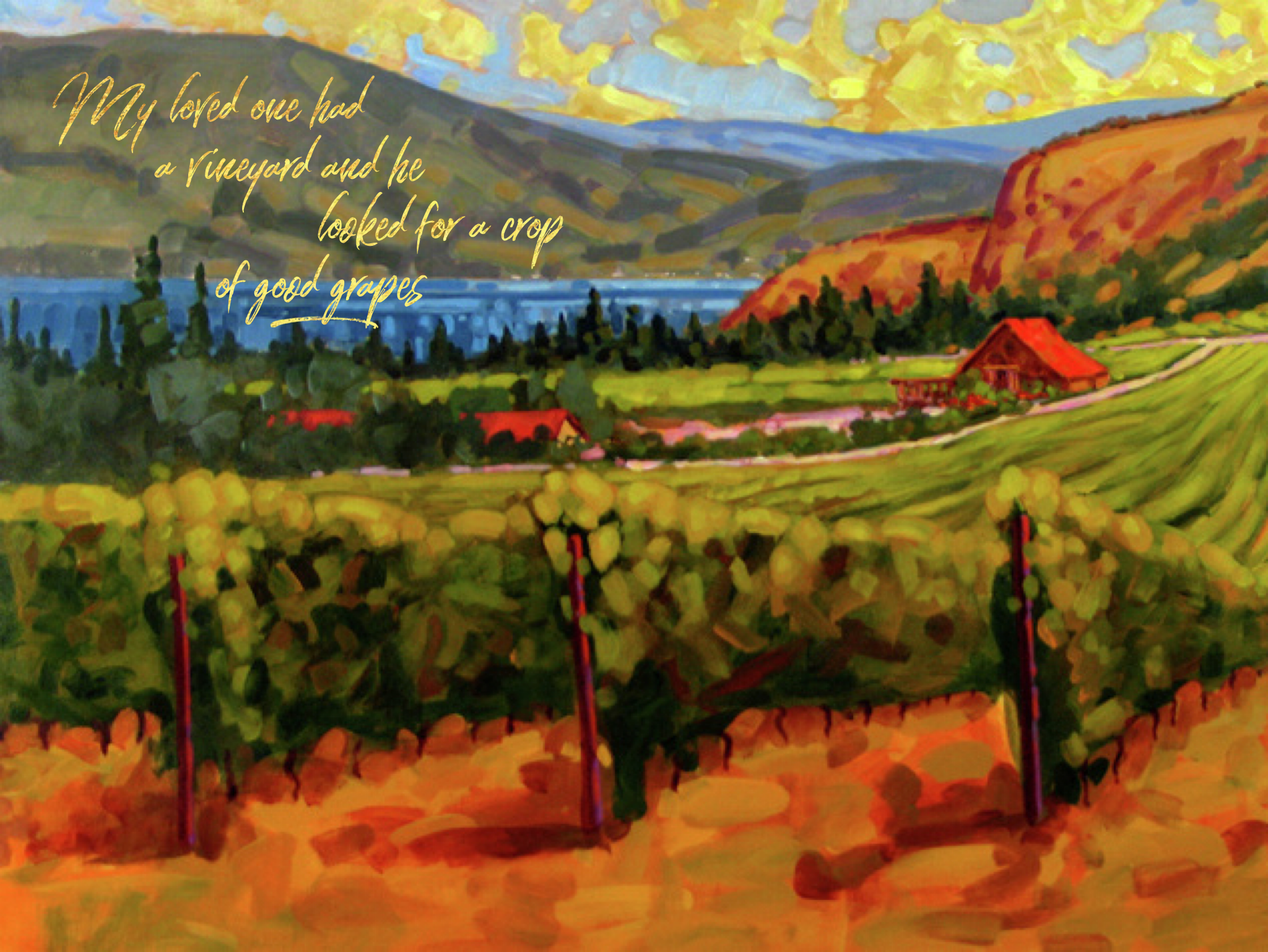
In the Isaiah 5, the prophet begins to sing a song about a vineyard and a vintner. This vintner loved his vineyard and put everything he had into it. He managed to get the “just right” conditions. He built a watchtower so he could see and protect the vineyard from anything that threatened to come in a wipe it out. The vintner did everything according to plan. And then… and then… the time came for the crop. The grapes should have been perfect. But the grapevines yielded only bad fruit. It was all sour grapes.

In v. 3, the text shifts from the prophet singing a song about a vineyard and a vintner to God speaking in the first person. We realize that the vintner is God, and God is angry about the failed crop of the vineyard that he so carefully and attentively cultivated. God is ready to destroy the vineyard. He’s ready to let the proverbial wildfires come in and make it a wasteland where only briars and thorns can be found. In v. 7, we find out that the vineyard is representative of the southern kingdom of Judah (which is where Isaiah did his prophetic work).

But what exactly was the “bad fruit” of Judah? What was it that made God so angry with his people? The prophets in both the northern and southern kingdoms tended to have two main criticisms that they articulated over and over again: the people needed to stop worshipping idols and the people needed to stop inflicting injustices upon the vulnerable. In this instance, the accusation against the people of Judah falls in line with the second of the two criticisms: where there should justice (mishpat), there is bloodshed (mispakh), and where there should be righteousness (tsedaqah), there are cries of distress (tse’aqah).

Justice here does not simply mean appropriate punishment for wrongdoings. Justice, in the biblical sense, has a much greater breadth of meaning. Justice is about the world being as it should. It is about wrongs being made right. It is about a vision of a society where the vulnerable are no longer vulnerable, and rather than exploitation, there is equity. Justice is about a social order where all of God’s people flourish.

Similarly, righteousness also has a social component. While the word “righteousness” for us often connotes a sort of personal purity and piety, in the biblical sense, righteousness is also relational. It has a connotation of “doing right” by one another.

If justice is about creating a right order where all people can flourish, righteousness is about each person looking out for their neighbors. That sounds like the kind of world I want to be a part of. That is certainly the kind of world God hoped his people would work to create. But instead of finding justice and righteousness, God finds bloodshed and cries of distress. He finds manipulation, exploitation, and everyone only looking out for number one. Let the vineyard be destroyed, God declares.

But then, a few chapters later, we shift metaphors, but we see that God does not leave God’s people to be destroyed, after all. Instead, we find God proclaiming anew the vision of justice and righteousness that God has for God’s people. God has not given up hope!

Some days, when I look at the world around me, I become overwhelmed. On those days, I become pessimistic at best, and nihilistic at worst. I get angry at all of the ways in which we, as human beings hurt one another. I feel rage at the evil we commit. I feel like I understand Isaiah’s vineyard song.

But God doesn’t leave us with the vineyard song. God leaves us with the image of the shoot that comes out of the stump of Jesse. God leaves us with new life coming out of that which appears to be dead. God leaves us with the vision of his kingdom – the kingdom of Jesus Christ, which is good news to the poor and needy. It’s good news to those who are crushed beneath the wheels of injustice. It’s good news to those who are trampled by unrighteousness. God leaves us with the vision of his kingdom – one that comes into existence through the gift of the Spirit. As you meditate today upon these words of Scripture, may God instill in you the vision of the kingdom and courage of the Spirit to work toward its reality.

Ponder

o   What words, phrases, or images from the text speak to you? What thoughts or feelings do they evoke?
o   Where, in our world, do you see injustice and unrighteousness?
o   Where do you catch glimpses of God’s kingdom being made a reality? What can you do to be a part of that?

Challenge

Enjoy some grapes, or fruit, or other type of food that comes from the ground. As you eat and taste the sweetness of the food, meditate on this passage again. As you think on it while engaging your senses in this different way, pay attention to what new insights or thoughts God might be showing you.

And/or 

Consider an injustice that is occurring in your own community. It might be related to food security, access to medical care, or any number of things. Identify one thing that you can immediately do about it, and then do it. It may be as simple as taking food to a neighbor who sometimes goes without or driving a friend to a doctor’s appointment. It could be volunteering with an organization that directly addresses social needs. It might even be working to change or create laws that care for the most vulnerable.

Prayer

God, you are the great vintner and you continue to nurture your vineyard. You want your vineyard to be a place where all vines can flourish. You want your vineyard to be a place where all may find the sweetest of fruit. Cultivate me, that I might be a vine rooted in Jesus Christ. Prune me, that I might bear the good fruit of justice and righteousness. Through your Spirit, may I work with you, as you give me a vision of your world. In Jesus’ name I pray. Amen.

-Cindy+

 

Letter to a Wayward Church

This letter began as an exercise as I was meditating on Hosea 11:1-11 in preparation for preaching this coming Sunday. It quickly morphed into a piece inspired by the Hosea text, the Good Friday Reproaches, and Luke 15:11-32, among other things. I imagined this from the perspective of God, and while traditionally, God is referred to as Father (even though God is not actually gendered), I chose to sign the letter as “Mama,” since as I was writing I couldn’t help but to tap into my own love for the toddler who calls me “mama.”

My Beloved Church,

When you were a child, dear Church, I loved you. Out of bondage I called you. From worldly institutions I freed you. When the categories of Jew and Gentile, male and female, slave and free mattered for where you stood, I rendered them void. You were my own beloved child, the center of my heart. I brought you up sitting at my dinner table. At my table there was no superior or inferior. From the margins and from the center, I brought you in and gave you a new vision of the world.

When Caesar saw fit to lay the yoke of oppression upon you, I gave you a kingdom far more beautiful and expansive than the Pax Romana could ever provide. When death cornered you, I opened up the door to life that can never be extinguished.

I touched the lame, the leper, the bleeding woman. I called them by name, just as I call you by name. I gave the outcast the seat of honor at my banquet. I showed you that you do not have to live by the rules of the world – the rules that keep the rich in power and keep the poor down and out. I showed you that the categories you place upon one another don’t mean a thing in my home.

When you were a child, dear Church, I dreamed that you would grow and start a revolution of grace and love – of care for your neighbor, just as I taught you and showed you how to do. I dreamed that my kingdom would spread on earth – not through conquest or the use of forced conversion, but through the abundant love you would give to everyone created in my image.

Remember how you would call upon my name? How you would only have eyes for me? Remember the zeal the Spirit put within you at the start? To you I was like the one who would lift you to my cheek and then gleefully run with you in the field, as you experienced the freedom from the constraints of empire.

To you, I was like the one who held your hand as you learned to take your first steps of your fledgling faith and community. I picked you up when you stumbled and comforted you when you were afraid.

But soon, you were walking on your own. And then you were running. And before I knew it, I found that you preferred the company of emperors and kings to mine. Before I knew it, you had traded in your white robe and basin for the imperial purple and a scepter. You made friends with the war hammer and sword, with the crossbow and battle axe. You carried them in my name. You used my cross as a symbol of dominance rather than sacrificial love.

As you strayed further afield, all while keeping the name I gave you, the name of Church, you forced baptisms of peoples under threat of death – not so they could know my grace, but so that you could make them pliable citizens of your earthly kingdom. How quickly did you forget the ways that I raised you!

Oh, you had moments where you remembered your true self. There were moments where those voices from within you tried to call you back to justice, to mercy, to reach out for my hand and walk with me. But all too quickly, you silenced those voices.

There were other times when I thought you might be finding your way back to me. When I thought your vision was clearing and you were remembering the joy of your life in my home. But you were still so entrenched in the power systems of the world that you could not or would not fully untie yourself.

You forgot that I had rendered null and void the categories of master and slave when you embarked on a centuries-long endeavor to buy and sell human beings as chattel, to prop up the economic systems that kept you powerful, all while invoking my name and twisting my words to justify it. Did you forget that I broke you free from these very things when I gave birth to you, my Church? Why, oh why, do you keep going back?

You tore people from their land, land you claimed “for me.” You brutally ravaged a people you called uncivilized savages. You forgot that they, too, were my children. You, my Church, acted the savage!

You watched and even helped as my firstborn, Israel, was rounded up and sent to death camps. You used the words of my holy book to embolden and enflame hatred against them. You forgot that you are not my only child and that I love my firstborn as much as I love you!

Why, my beloved Church have you strayed so far? Why have you set up flaming crosses and lynching trees? Why do you continue to worship the god of nationalism and white supremacy? Why do you still trample my children who don’t look like you or behave like you do? Why have you tried so hard to hold on to riches and power? Why do you endlessly debate the worth of any of my children? Why do you fight so hard to protect unjust institutions? Why do you build walls, when on the cross, I tore them all down? Do you not remember the true nature of my kingdom? Do you not remember that the last shall be first?

What shall I do with you, my Church? Shall I leave you to your own devices? Shall I wash my hands of you? I should leave you to your own destruction. I should let your rage and fear tear you apart. I’ll turn my back and leave you out in the cold. Not that you would even notice. It has been so long since we’ve truly shared life in the home I made for you. I should disown you and be done with it. I’m sick and tired of watching you live this way. It breaks my heart every time I think of how I’ve loved you. I am heartsick over you, my wayward Church.

I should lock my door and take away your place at my dinner table. I should close your bedroom door and let your things collect dust as I put you out of my mind. I should stop standing at the end of the road, hoping to catch a glimpse of you. You are too far gone. You are not the same child I once loved. You are never coming back.

But O, how can I give you up, my child?
How can I hand you over, my Church?
How can I treat you as one long dead?
How can I make you as a distant, closed off memory?
My heart will not let me. You are mine, and always will be.
How I love you still! How I will always long for you!
My heart will never grow weary of waiting for you.
There will always be a place for you at my dinner table.
Every day I will go to the end of the road, waiting to catch a glimpse of you.
Every day I will call out for you.
Every day I will sing the songs I sang to you as an infant, hoping the song will reach your ears;
Hoping the song will remind you of your true home.
I will keep on singing the songs of justice, of mercy, of love.

One day you will hear. One day, they will bring you out of your palaces, out of your stupor, out of yourselves. One day they will bring you back down the highway, the road, and then the narrow path to my home – to your home. You’ll find the door open and the table set.

My child, my beloved Church, I dream of this day. Please, let it be soon.

With Love Always,
Mama

The Reflectionary – Week of November 3, 2019

Text: Hosea 11:1-11

“When Israel was a child, I loved him,
and out of Egypt I called my son.
But the more they were called,
the more they went away from me.
They sacrificed to the Baals
and they burned incense to images.
It was I who taught Ephraim to walk,
taking them by the arms;
but they did not realize
it was I who healed them.
I led them with cords of human kindness,
with ties of love.
To them I was like one who lifts
a little child to the cheek,
and I bent down to feed them.
 

“Will they not return to Egypt
and will not Assyria rule over them
because they refuse to repent?
A sword will flash in their cities;
it will devour their false prophets
and put an end to their plans.
My people are determined to turn from me.
Even though they call me God Most High,
I will by no means exalt them.

“How can I give you up, Ephraim?
How can I hand you over, Israel?
How can I treat you like Admah?
How can I make you like Zeboyim?
My heart is changed within me;
all my compassion is aroused.
I will not carry out my fierce anger,
nor will I devastate Ephraim again.
For I am God, and not a man—
the Holy One among you.
I will not come against their cities.
They will follow the Lord;
he will roar like a lion.
When he roars,
his children will come trembling from the west.
They will come from Egypt,
trembling like sparrows,
from Assyria, fluttering like doves.
I will settle them in their homes,”
declares the Lord.

Reflection

Several generations have passed since the rule of King Ahab and the showdown between Elijah and the prophets of Baal. Even more generations have passed in the kingdom of Israel (the northern kingdom comprising of 10 tribes) since it broke off from the southern kingdom of Judah, under the leadership of their first king, Jeroboam. In Hosea’s time, another Jeroboam has risen to power as king – Jeroboam II.

According to archeological findings, the rule of Jeroboam II had brought the northern kingdom of Israel to the greatest prosperity it had known. Of course, that meant prosperity for the wealthy and powerful. It meant prosperity for the king. It also meant a yoke of oppression and exploitation of the poor in the kingdom. Jeroboam II was a king who was skilled in negotiating trade (especially with Egypt and Assyria, who were much larger, more powerful, and potential threats to Israel), but he was also a king given to excessive shows of wealth and amusements. He also continued the practices of worship at the altars Jeroboam I had set up in Dan and Bethel. In other words, the practices of idol worship had been continuing for these many generations under the kings of Israel.

Hosea and his contemporaries (Joel and Amos), were prophets during this time. They criticized two main things: the continued idol worship and the exploitation and oppression of the poor. Much of the book of Hosea are pronouncements of judgment and doom upon God’s unfaithful people, but especially upon the powerful who lead those in their kingdom astray. Hosea, himself, in fact, marries an unfaithful woman named Gomer, whom he still loves despite her unfaithfulness. Hosea sees his own marriage as symbolic of God’s relationship with Israel.

In this particular passage today, however, we see not the doom and the gloom we find in most of Hosea. Instead, we find God wrestling with his love for his people even as they are unfaithful to him. Notice the tender and affectionate language of the opening verses. Notice the language of nurture and of care for Israel as a vulnerable but beloved little child. In these words, I can recognize my affection and tenderness towards my own son, my little toddler, who still relies so fully on me. I think of the many times I lift him to my cheek in an embrace. Maybe you can recognize your own love in these words for your children when they were tiny, or your grandchildren.

Then the text takes a bit of a turn, as God looks at them like a parent of a rebellious teenager heading down a destructive path. We see God express frustration and downright anger that the beloved child is making these choices. We get the sense that God is getting so fed up with his child that he’s about to wash his hands of Israel. It’s time for tough love. It’s time to leave Israel to his own doom. My child is still a toddler, but I know the teenage and young adult years are coming, and a wonder (and fear) what they might bring. Maybe you, as a parent or grandparent know the anguish that God is expressing here.

But then, the text takes yet another turn, and it is almost as if we are overhearing a conversation that God is having with himself. He wants to be done with dealing with Israel. He wants to just cut his child off. But then, it as if God stops, and comes back to himself, and we hear the voice of the tender parent again: “How can I give you up, Ephraim? How can I hand you over, Israel?… My heart is changed within me; all my compassion is aroused.” In this text, we are reminded of the character of God. God’s very nature is one of compassion. Of forgiveness. Of second chances. God has always been thus. From the very beginning through the full realization and expression of that compassion in Christ Jesus, this is WHO GOD IS.

Remember, ancient Israel’s story was one of chronic unfaithfulness to God’s covenant. The leaders were constantly causing or at least enabling people to turn away and worship false gods. The powerful were constantly oppressing the vulnerable they were charged to shepherd and care for. This had been going on for a long, long time. God had every right to be angry, to be frustrated, to be ready to cut them off. That is, after all, how any human parent would probably feel under the same circumstances. Maybe you, yourself, have been there. But here, we are reminded that God is not, in fact human. God is holy. God is compassion. Alexander Pope’s words come to mind: “To err is human; to forgive is Divine.” Thanks be to God!

Ponder

o   What words, phrases, or images from the text speak to you? What thoughts or feelings do they evoke?
o   In what ways do you relate to God in this passage? In what ways do you relate to Israel?
o   Where have you experienced forgiveness and compassion in your life, whether from God or from others?

Challenge

Sometimes the hardest thing is recognizing the sin or pain that exists within ourselves. Take time this week to engage in the spiritual practice of journaling. Don’t think too hard about what to write, or grammar, or sentence structure. Just simply write, asking God to open up parts of your heart that need to be opened up.

And/or

Think about a time when you experienced compassion and forgiveness and what that did for you. Write a letter of gratitude to the person who offered it, or to God. If you are able to send the letter to the person, do so. It might be just what they need to hear.

Prayer

God, your love for me is beyond all comprehension. You bend over to lift me up to your cheek again and again. You hold me like a mother holding her newborn child, with tenderness and deep love. You always make room for me to sit down at your table, even when I run off and forget you, or worse, snub you and disown you. Thank you for never disowning me, even when you might have every reason. God, whose name is Love, soften my heart. May I hear your “roar” that always calls me home.  In Jesus’ name I pray. Amen.

-Cindy+