The Reflectionary – Week of September 8, 2019

Text: Genesis 32:9-13; 22-31

Then Jacob prayed, “O God of my father Abraham, God of my father Isaac, Lord, you who said to me, ‘Go back to your country and your relatives, and I will make you prosper,’ I am unworthy of all the kindness and faithfulness you have shown your servant. I had only my staff when I crossed this Jordan, but now I have become two camps. Save me, I pray, from the hand of my brother Esau, for I am afraid he will come and attack me, and also the mothers with their children. But you have said, ‘I will surely make you prosper and will make your descendants like the sand of the sea, which cannot be counted.’”
 
He spent the night there, and from what he had with him he selected a gift for his brother Esau.
_________
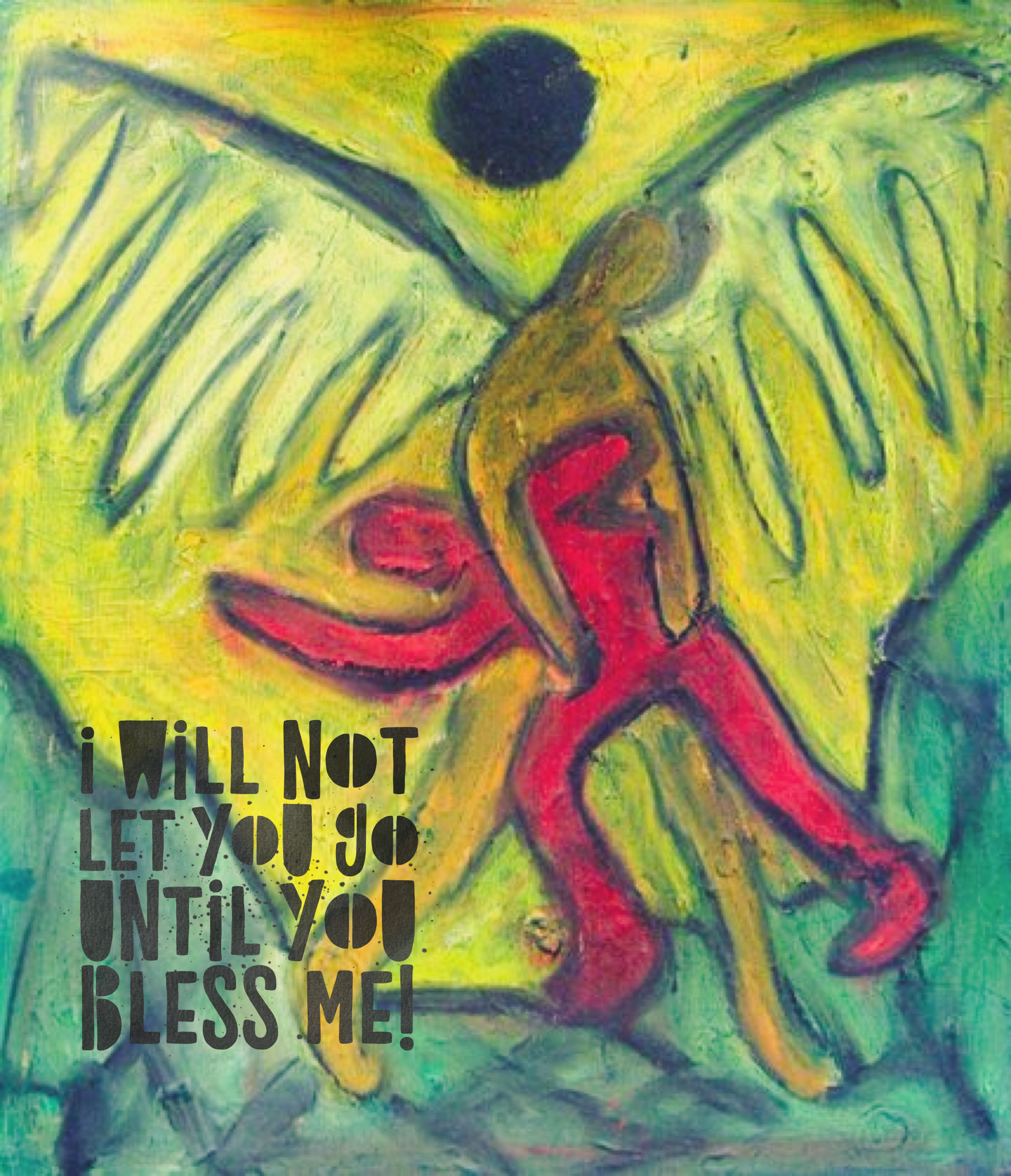
 
So Jacob was left alone, and a man wrestled with him till daybreak. When the man saw that he could not overpower him, he touched the socket of Jacob’s hip so that his hip was wrenched as he wrestled with the man. Then the man said, “Let me go, for it is daybreak.”
 
But Jacob replied, “I will not let you go unless you bless me.”
 
The man asked him, “What is your name?”
 
“Jacob,” he answered.
 
Then the man said, “Your name will no longer be Jacob, but Israel, because you have struggled with God and with humans and have overcome.”
 
Jacob said, “Please tell me your name.”
 
But he replied, “Why do you ask my name?” Then he blessed him there.
 
So Jacob called the place Peniel, saying, “It is because I saw God face to face, and yet my life was spared.”
 
The sun rose above him as he passed Peniel, and he was limping because of his hip.

Reflection

This scene is one of my favorite scenes from Scripture. In it, we find a knock-down, drag-out wrestling match between Jacob and this mysterious man. The scene begins with Jacob anxiously preparing for his impending meeting with Esau. Esau, his older twin brother, whom he tricked out of his birthright. Esau, who was understandable angry with his sneaky and dishonest younger twin.

It is a strange scene to imagine – this wrestling that goes from dusk until dawn. This was no polite wrestling match. There were no referees to blow the whistle and call illegal holds. It was an intense match – so much so that Jacob got his hip knocked out of joint. They wrestled, and then they wrestled more. Jacob must have been to the point of exhaustion, and the mysterious man was ready to throw in the towel. He was done.

But then Jacob says, “I will not let you go unless you bless me!”

When we read this story, we see that the blessing actually comes through the knock-down, drag-out wrestling match. Through the exhaustion, through the pain of getting his hip knocked out of joint – through the struggle, Jacob find his blessing.

This story is a good metaphor for how we engage Scripture. We don’t come to it cleanly or plainly. We don’t come to it without struggle. There are some big questions that the Bible raises. If we are really reading it, we find ourselves asking all kinds of questions. Questions relating to the violence and even genocide we find within its pages; questions about the nature of God; questions about good and evil; questions about what it means to live in today’s world. And as we wrestle, we might be overwhelmed. We might get our hips knocked out of place. We might be downright exhausted with all of the questions that we can’t really find satisfactory answers to.

But when we aren’t afraid to wrestle, God gives a blessing. When we aren’t afraid to ask the hard questions, God works through our struggle. As my favorite college professor, Dr. Jeffrey Pugh, always reminded me, “Faith isn’t about finding all of the answers, it’s about learning to live with the questions.”

May you find blessing in the questions.

Ponder

o  What words, phrases, or images from the text speak to you? What thoughts or feelings do they evoke?
o  What have you been wrestling with in Scripture?
o  Where, in your life, have you seen blessing come through struggle?

Challenge

Think about a passage or an idea in the Bible that you have been struggling with. Write about your struggle and the questions it raises. Talk to a friend about it, talk to God about it.

And/or

Notice a family member, friend, or co-worker who has been struggling. Find a way to give them a blessing this week.

Prayer

God, you are ever-present with me, and maybe even especially when I am struggling. Give me the endurance to wrestle faithfully. Give me the courage to ask the hard questions. Give me a heart to trust you when I find answers I don’t like, or even no answers at all. And through it all, may I experience your blessing. In Jesus’ name, I pray. Amen.

– Cindy+

The Reflectionary – Week of September 1, 2019

Text: Genesis 18:1-15; 21:1-7

The Lord appeared to Abraham near the great trees of Mamre while he was sitting at the entrance to his tent in the heat of the day. Abraham looked up and saw three men standing nearby. When he saw them, he hurried from the entrance of his tent to meet them and bowed low to the ground.
 

Abraham and the Three Angels by Marc Chagall

He said, “If I have found favor in your eyes, my lord, do not pass your servant by. Let a little water be brought, and then you may all wash your feet and rest under this tree. Let me get you something to eat, so you can be refreshed and then go on your way—now that you have come to your servant.”
 
“Very well,” they answered, “do as you say.”
 
So Abraham hurried into the tent to Sarah. “Quick,” he said, “get three seahs of the finest flour and knead it and bake some bread.”
 
Then he ran to the herd and selected a choice, tender calf and gave it to a servant, who hurried to prepare it. He then brought some curds and milk and the calf that had been prepared, and set these before them. While they ate, he stood near them under a tree.
 
“Where is your wife Sarah?” they asked him.
 
“There, in the tent,” he said.
 
Then one of them said, “I will surely return to you about this time next year, and Sarah your wife will have a son.”
 
Now Sarah was listening at the entrance to the tent, which was behind him. Abraham and Sarah were already very old, and Sarah was past the age of childbearing. So Sarah laughed to herself as she thought, “After I am worn out and my lord is old, will I now have this pleasure?”
 
Then the Lord said to Abraham, “Why did Sarah laugh and say, ‘Will I really have a child, now that I am old?’ Is anything too hard for the Lord? I will return to you at the appointed time next year, and Sarah will have a son.”
 
Sarah was afraid, so she lied and said, “I did not laugh.”
 
But he said, “Yes, you did laugh.”
_________
 
Now the Lord was gracious to Sarah as he had said, and the Lord did for Sarah what he had promised. Sarah became pregnant and bore a son to Abraham in his old age, at the very time God had promised him. Abraham gave the name Isaac to the son Sarah bore him. When his son Isaac was eight days old, Abraham circumcised him, as God commanded him. Abraham was a hundred years old when his son Isaac was born to him.
 
Sarah said, “God has brought me laughter, and everyone who hears about this will laugh with me.” And she added, “Who would have said to Abraham that Sarah would nurse children? Yet I have borne him a son in his old age.”

Reflection

Have you ever had someone tell you something, and your first thought was, “Yeah, right, that’ll happen when pigs fly!”? That was exactly Sarah’s reaction when the visitor told her that she would bear a son. She was well past her child-bearing years, and if she wasn’t able to get pregnant during her “fertile” years, how in the world was she going to get pregnant now?

This is not the first time that Abraham and Sarah have heard this promise. In Genesis 15, God tells Abraham that he will have a son of his own flesh and that his offspring will be as numerous as the stars. Abraham and Sarah don’t have any inkling how this will actually happen as they are both old and Sarah is past child-bearing years. Sarah comes up with her own plan to make God’s plan work – Abraham will sleep with Sarah’s slave, Hagar, get her pregnant, and bear a son of his own flesh through her (and let’s not even get started on how messed up that whole situation is). Abraham agrees, and Sarah’s manipulative and abusive plan for Hagar achieves her desired results. Hagar bears a son named Ishmael. Much familial abuse and dysfunction ensues.

Now, some years have passed. Ishmael is growing, and God speaks to Abraham again, telling him that Sarah, specifically, will bear him a son, to be named Isaac. God further clarifies the nature of God’s covenant with Abraham and future generations of his family, and Abraham and all of the men and boys belonging to Abraham’s household are circumcised as a sign of that covenant. Laughter and disbelief are Abraham’s response to God’s promise about Sarah’s impending pregnancy.

And yet – despite their disbelief, despite their laughter, God brings the plan about. Not as Sarah or Abraham tried to orchestrate it (which led to much strife and abuse), but as God orchestrated it. Sarah does indeed bear a child well past her child-bearing years, and her laughter of derision and disbelief turns to the laughter of sheer joy and the overwhelming nature of God’s grace.

Did Abraham and Sarah deserve this gift? My own personal impulse, after what they did to Hagar and Ishmael, is to say, “No, absolutely not!” But that’s the thing about God’s grace. It is not dependent upon “deserving” it. God’s grace is a free, and undeserved gift.

Often, as Christians, we are tempted to restrict the idea of grace to the New Testament – “That’s something Jesus brought us,” we say. And yet, when we look at this story, among many others in the Hebrew Bible, aka the Old Testament, we find that God’s grace has actually been present all along. May we all catch glimpses of God’s grace in unsuspected places!

Ponder

o  What words, phrases, or images from the text speak to you? What thoughts or feelings do they evoke?
o   Where in your life have you seen God accomplish an “impossible” task?
o   Who might you have you hurt in the name of accomplishing your own plans?
o   Where have you seen God’s grace at work this past week?

Challenge

Each evening this week, before you go to bed, take a few moments to pause, reflecting back over your day, and identify the moments or experiences where you have seen God’s grace. Give thanks to God for those moments.

And/or

Reach out to someone you have hurt. Talk with them openly and honestly. Repent. Seek forgiveness. Accept their response, whatever it may be.

Prayer

Surprising God, you are always on the move. Thank you for the ways that you show up when I am least expecting it. Forgive me for the ways that I try to manipulate your plans for me. Forgive me for the times where I fail to trust you. Give me the strength to make things right with those I have hurt, with those I have used, and with those I have cast aside. May your grace be continually at work in my heart, not because I deserve it, but because you desire it. Turn my derision and disbelief into laughter and joy. Fill me with your Spirit and your love. In Jesus’ name, I pray. Amen.

– Cindy+

The Reflectionary – Week of August 25, 2019

Text: Genesis 2:4b-25 (NIV)

This is the account of the heavens and the earth when they were created, when the Lord God made the earth and the heavens.
 
Now no shrub had yet appeared on the earth and no plant had yet sprung up, for the Lord God had not sent rain on the earth and there was no one to work the ground, but streams came up from the earth and watered the whole surface of the ground. Then the Lord God formed a man from the dust of the ground and breathed into his nostrils the breath of life, and the man became a living being.
 
Now the Lord God had planted a garden in the east, in Eden; and there he put the man he had formed. The Lord God made all kinds of trees grow out of the ground—trees that were pleasing to the eye and good for food. In the middle of the garden were the tree of life and the tree of the knowledge of good and evil.
 
A river watering the garden flowed from Eden; from there it was separated into four headwaters. The name of the first is the Pishon; it winds through the entire land of Havilah, where there is gold. (The gold of that land is good; aromatic resin and onyx are also there.) The name of the second river is the Gihon; it winds through the entire land of Cush. The name of the third river is the Tigris; it runs along the east side of Ashur. And the fourth river is the Euphrates.
 
The Lord God took the man and put him in the Garden of Eden to work it and take care of it. And the Lord God commanded the man, “You are free to eat from any tree in the garden; but you must not eat from the tree of the knowledge of good and evil, for when you eat from it you will certainly die.”
 
The Lord God said, “It is not good for the man to be alone. I will make a helper suitable for him.”
 
Now the Lord God had formed out of the ground all the wild animals and all the birds in the sky. He brought them to the man to see what he would name them; and whatever the man called each living creature, that was its name. So the man gave names to all the livestock, the birds in the sky and all the wild animals.
 
But for Adam no suitable helper was found. So the Lord God caused the man to fall into a deep sleep; and while he was sleeping, he took one of the man’s ribs and then closed up the place with flesh. Then the Lord God made a woman from the rib he had taken out of the man, and he brought her to the man.
 
The man said,
 
“This is now bone of my bones
    and flesh of my flesh;
she shall be called ‘woman,’
    for she was taken out of man.”
That is why a man leaves his father and mother and is united to his wife, and they become one flesh.
 
Adam and his wife were both naked, and they felt no shame.

Reflection

In this second of the two creation stories in Genesis (the first one being in chapter 1), we find the emphasis placed upon relationship: relationship between God and human, between human and creation, and between human and human. There is an “earthy” feel to this text. You can sense the connection between the Creator, creature, and creation.

In fact, we gain an even greater sense of this relational connection through the Hebrew text, which is ripe with word play. When God creates the human being from the dust of the earth, God creates ha adam from ha adamah. In English, we miss the linguistic connection. A different translation that emphasizes this word play might be, God created the “human” from “humus.” We hear the connection between human beings and the rest of creation. We are all made of the same “stuff,” so to speak.

Furthermore, the text says that God breathed the breath of life into the human. Once again, the Hebrew reveals an idea that we might miss in English. In Hebrew, the word for breath, ruach, is also the same word for spirit and wind. The ruach hovered over the waters and was instrumental in creation in Genesis 1. Ruach is what God now gives to the human being that he might come alive.

When we read Genesis 2, we can’t help but to see that human beings are fundamentally created for relationship. We are created to be in relationship with our Creator, the one who gives us the ruach of life. We are created to be in relationship with the rest of creation, which God has commanded us to keep and to care for. And finally, we are created to be in relationship with one another. God creates human beings for one another, as demonstrated through that first relationship of Genesis 2. We, human creatures, are not meant to be alone. We need one another – we are part of one another.

The poet John Donne’s words ring true:

No man is an island entire of itself; every man
is a piece of the continent, a part of the main;
if a clod be washed away by the sea, Europe
is the less, as well as if a promontory were, as
well as any manner of thy friends or of thine
own were; any man’s death diminishes me,
because I am involved in mankind.
And therefore never send to know for whom
the bell tolls; it tolls for thee.

MEDITATION XVII
Devotions upon Emergent Occasions
John Donne

Ponder

o  What words, phrases, or images from the text speak to you? What thoughts or feelings do they evoke?
o  Where in creation have you felt particularly connected to God?
o  In what areas of your life do you need God to breathe new life into you?
o  Even though as human beings we are created for relationship with one another, we all experience brokenness and struggle. With whom might God be calling you to reconcile, restore, or strengthen your relationship? To whom might God be calling you to reach out?

Challenge

Spend some time in creation this week, whether it is sitting on your porch, listening to the birds sing, hiking a trail, or walking by the river. Give thanks to God for the beauty and wonder of God’s creation, and then do something to take care of it, whether it is picking up litter, reducing your use of one-time plastics, tending your garden, or anything else that God moves you to do.

And/or

Think of one person with whom you want to strengthen your relationship. Reach out. Make a call. Bake cookies. Stop by for a visit. Send a card. Let them know you are thinking of them. Listen to the promptings of the ruach!

Prayer

Living God, you have created us all for relationship. Thank you for the beauty and goodness that you continually reveal in the world around me. Place your ‘ruach’ within me, that I might live and flourish in the world that you have created. May I grow in love of You, of your creation, and of all who have been created in your image. Place within my heart your desires; your impulses. Guide me each moment of this week, that your thoughts would be my thoughts, that your words would be my words, and that my deeds would be your deeds. In Jesus’ name, I pray. Amen.

– Cindy+