The Reflectionary – Week of September 15, 2019

Text: Exodus 3:1-15

Now Moses was tending the flock of Jethro his father-in-law, the priest of Midian, and he led the flock to the far side of the wilderness and came to Horeb, the mountain of God. There the angel of the Lord appeared to him in flames of fire from within a bush. Moses saw that though the bush was on fire it did not burn up. So Moses thought, “I will go over and see this strange sight—why the bush does not burn up.”

When the Lord saw that he had gone over to look, God called to him from within the bush, “Moses! Moses!”

And Moses said, “Here I am.”

“Do not come any closer,” God said. “Take off your sandals, for the place where you are standing is holy ground.” Then he said, “I am the God of your father, the God of Abraham, the God of Isaac and the God of Jacob.” At this, Moses hid his face, because he was afraid to look at God.

The Lord said, “I have indeed seen the misery of my people in Egypt. I have heard them crying out because of their slave drivers, and I am concerned about their suffering. So I have come down to rescue them from the hand of the Egyptians and to bring them up out of that land into a good and spacious land, a land flowing with milk and honey—the home of the Canaanites, Hittites, Amorites, Perizzites, Hivites and Jebusites. And now the cry of the Israelites has reached me, and I have seen the way the Egyptians are oppressing them. So now, go. I am sending you to Pharaoh to bring my people the Israelites out of Egypt.”

But Moses said to God, “Who am I that I should go to Pharaoh and bring the Israelites out of Egypt?”

And God said, “I will be with you. And this will be the sign to you that it is I who have sent you: When you have brought the people out of Egypt, you will worship God on this mountain.”

Moses said to God, “Suppose I go to the Israelites and say to them, ‘The God of your fathers has sent me to you,’ and they ask me, ‘What is his name?’ Then what shall I tell them?”
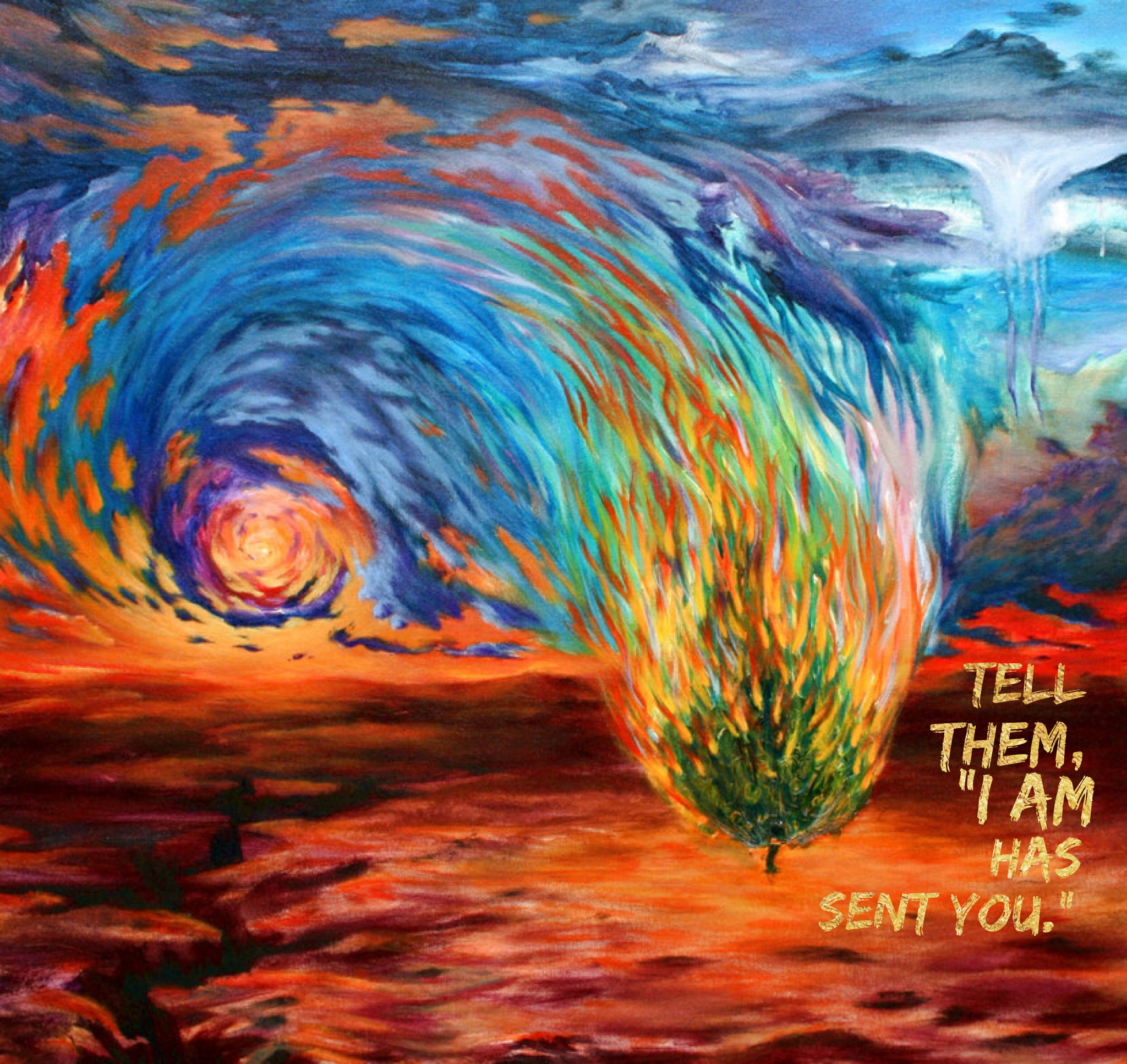
God said to Moses, “I Am who I Am. This is what you are to say to the Israelites: ‘I Am has sent me to you.’”

God also said to Moses, “Say to the Israelites, ‘The Lord, the God of your fathers—the God of Abraham, the God of Isaac and the God of Jacob—has sent me to you.’

“This is my name forever,the name you shall call mefrom generation to generation.”

Reflection

This moment where Moses comes upon the burning bush is one of the most pivotal moments in all of the Bible. While God had appeared and made a covenant with others before now, here is where God reveals God’s own name.

Moses has already been through much. He’d already been sent by his mother down the river in an effort to save him. He’d already been brought into Pharaoh’s household and raised by Pharaoh’s daughter. He’d already fled after killing an Egyptian task-master. He’d already married and was living as a shepherd in the land of Midian, watching the oppression from his people, the Israelites, from afar.

Moses was one who had been continually driven away from home. He was driven away first from his mother, then from his adoptive family, then from his people. When Moses comes across the burning bush, the concept of “home” was probably one that was blurry at best for him.

And then Moses hears the voice: “Moses! Moses! Take off your sandals!”

God tells him to do so because he is standing on holy ground. Taking off the sandals, is, after all, a sign of respect. But God is communicating something else as well in this command. Taking off the shoes is also a sign of being welcomed home.

Many people have a “no shoes in the house” rule. When you enter their home, you take your shoes off and you leave them by the door. While for some, this might be about keeping the carpet clean, for some, it is also a way of saying, “make yourself at home!”

When God tells Moses to take off his shoes, God is saying to him, “Welcome home! Kick off your shoes! This is where you are supposed to be!”

YHWH is the revelation of the Divine Name. It means something akin to “I Am who I Am” or “I Will Be who I Will Be.” In the revelation of God’s own name to Moses, God says, “I Am with you.” God shows Moses that the God who was, and is, and will be is the one in whom he can find his true understanding of home.

And yet, even as God calls Moses to the comfort of knowing to whom he truly belonged, he also called Moses to the task of his lifetime – leading his people out of Egypt and the bonds of slavery and oppression. Moses was given his home, but he was also given his life’s mission. Belonging to God didn’t mean a life of ease or comfort. It meant a life of fighting against injustice. It meant a life of constantly being threatened by the powers that be. It meant a life of wilderness wanderings, deep frustration, and hardship.

Home with God doesn’t always mean rainbows and unicorns. It doesn’t always mean comfort and prosperity. If Moses’ life shows us anything, it is that the opposite is more likely true. And yet… when God reveals God’s self to us and invites us home, nothing else can compare.

Moses could not have anticipated what would happen that day as he was tending his father-in-law’s sheep. He could not have known what God would show him. He could not have known what God would give him, in the revelation of the Divine Name.

When God reveals the Divine Name to Moses, God also reveals Moses’ true identity, his true purpose, his true home. It is in God and among God’s people. May God reveal the same to us.

Ponder

o  What words, phrases, or images from the text speak to you? What thoughts or feelings do they evoke?
o  What is “home” to you? What qualities does it have?
o  When have you experienced true belonging? How can you help others experience that, especially within your community of faith?

Challenge

Consider someone who is a part of your family, whether it is by blood, by love, or by faith. Think of something you can do to help them feel a deeper sense of belonging this week, and then do it.

and/or

Maybe you know someone who isn’t living at home right now. It could be a college student, it could be someone in the hospital, it could be someone who has moved to assisted living. Call, visit, or send them something to help make their space feel a little bit more like home.

Prayer

Holy God, you call me to remove my shoes – to make myself at home in you and among your people. You are the God who IS. You will always be with me. Through the peace of knowing that I will always belong to you, lead me out to do your work. Give me clarity in your mission and purpose for me, and give me the strength and courage to live it. In Jesus’ name, I pray. Amen.

-Cindy+
Sarah – A Survivor Story

Below is both the audio and the text of a monologue I delivered on September 8, 2019 at St. Paul and Brown United Methodist Churches. Inspired by my reading of Womanist Midrash by Wilda C. Gafney, I imagined how the matriarch Sarah might have described her life in her own words. The manuscript varies slightly from my actual delivery.

Text:

My days are almost gone. They are fading fast like the setting sun. I’ve lived for 127 years. It has been a long 127 years. When I look back on my life, I ask myself, would I have done it differently? Could I have done it differently?

When people remember me, what will they remember? A matriarch, full of blessing, full of faith? Or will they see what I see, a woman who has been hurt and in her anger and desperation has hurt others terribly?

Most people know me because of my husband, Abraham. What a great man of faith, they say. And in many ways, he was. But in many ways, he, like the rest of us, had moments where he did not trust the Almighty and took matters into his own hands. There were times where his fear seemed to strip him of his faith.

Most people think of us like two peas in a pod. Where there is one, there is always the other. And that is true. There has never been a time in my life where Abraham has not been a part of it. He was, after all, my older brother first, before he was my husband – we share the same father, Terah. He had already been in the world for 10 years when I came into it. For most of my childhood, I knew that I would have to marry him. Our father said that it was the best way to carry on his family line. I never really questioned it. It was just going to be what it was going to be.

As I got older though, I started to attract the attention of the village boys. There was one in particular that I liked, with long, dark hair, and intense eyes. He picked a flower for me one day and tucked it behind my ear. I hoped that maybe I could talk my father into letting me marry him instead. Do you know that I can’t even remember his name now? But he was from a good family, and I didn’t see that there could be anything bad about that arrangement. But my father said, absolutely not – he had plans for me and he wasn’t about to change them.

And so, as soon as I bled for the first time, my father said that it was time for me to be married. I knew there was no changing his mind, so Abraham (or Abram as he was known back then) and I were married, and I assumed the duties of a young wife, with the expectation that we would soon further the family line. A few months came and went, and no sign of a child. And then a few more months. We didn’t worry too much at first. I was, after all, still so young, and my bleeding was not yet regular. There was still plenty of time to have children, we told ourselves.

But then the months became years, and then the years became decades. There were a couple of times where I hoped – where the bleeding stopped for a month or two and I began to feel the sickness of early pregnancy. But as soon as I began started to let that hope take root, the bleeding would start. I never even told Abraham about those times. They have been my secret sadness for all of these years, and even now, even after all that has happened, I grieve for what might have been. But even as I held my own sadness close to me, I heard the whispers and murmurs around me – accusations that I’d taken something to prevent pregnancy, wonderings about why God had cursed me, calling me the worst of all words to a woman, “barren.” It was never Abraham’s fault, of course. Only mine.

That was me. Barren but beautiful. Desirable, but scorned. In a world where a woman’s worth was measured by her fertility, I was a cast off. Well, at least in that way. But Abraham found another way that I could be useful to him. I still tremble in rage when I stop and think about what he did. I can barely speak about it.

We had left our home because of famine. Our best chance was to go south to Egypt, so we did. But as we went, Abraham said to me, “We need to make a plan, going into Egypt. Sarah, you know you are a beautiful woman, and your beauty is much too tempting to men. When the Egyptians see you, they are going to be jealous of me if they know I am your husband. They might even try to kill me. So here’s what I need you to do for me. Do not let them know that I am your husband. As far as they are concerned, we are only brother and sister.”

I said to him, “But what about me? How will that help me?” Abraham said back to me, “As long as I am safe, it will be good for you. What will happen to you if I get killed?”

It seemed like he didn’t really answer my question, but I didn’t know what else to say, so I said nothing.

When we arrived in Egypt, as Abraham predicted, I immediately caught the eye of Egyptian men – and not just any Egyptian men, but the ones who served Pharaoh. They decided that I looked exactly like the kind of woman Pharaoh liked, and so, they approached Abraham and said, “We’d like to take your sister to the Pharaoh. Trust us, this will be a good arrangement for you.” I half-hoped that Abraham would find a way to prevent this from happening, but I knew in my heart that he would not.

I was taken into the Pharaoh’s harem, and into his bed that very night. I kept my face calm, but inside I was raging, and wondering how this could really be happening to me.

The next day, Pharaoh started sending over gifts to Abraham. At first it was a flock of sheep, but over the coming weeks, Pharaoh continued to lavish more upon him. My role in all of this was to keep my mouth shut and please Pharaoh. He was never cruel, but I was never more than a beautiful object in his eyes.

One day, Pharaoh fell ill – and then his first wife, and then his servants, and then his children. He tossed and turned in his bed, filled with anguish and fever. He sent for me, and demanded me to tell him what I had done to him. I was shocked at why he thought I had anything to do with this and I was very afraid. I didn’t know what to do, so I started sobbing and rambling, and I broke down and told him that I wasn’t free like he thought I was, and that Abraham wasn’t just my brother, he was also my husband. If Pharaoh could have gotten up out of bed, I believe he would have gotten up and flung me to the ground, he was so angry. He sent me away from him immediately and called in Abraham to confront him. I don’t know the details of that meeting, but I know that Abraham left in a hurry, and gathered me and the whole household he had acquired from Pharaoh’s gifts, and we left in the dead of night.

We were on the move for a time until we settled in Hebron. Abraham and I never talked about what happened in Egypt. I was too numb and too scared to even think about what had happened, even though I was reminded of it every single day as I looked around at our newly acquired wealth that had come through the giving of my body.

We settled into something of a rhythm of life. I managed the household and oversaw the work of our new servants. I poured myself into those tasks to help me forget about the days in Egypt and to help me forget about the fact that I still had no child. I was almost able to settle into an uneasy peace with my situation.

But then one day, Abraham barged into the house and started telling me about this supposed conversation he had with the Almighty. He declared that God told him that he would have a son, and that not only would he have a son, but his offspring would be as numerous as the stars in the sky. I just laughed at him. But he was so convinced. He was obsessed. It was all that he wanted to talk about. There was no pushing my barrenness to the back of my mind now. Abraham just about drove me mad with his constant talk of this promise God had supposedly made to him. God never bothered to talk to me about it.

His obsession became my obsession. I HAD to find a way to give him a child. I tried using herbs that were said to increase fertility, I talked to the midwife about things I could do. Nothing worked. I had given up, when one night, my young slave girl, Hagar, was preparing my bed. And then it hit me. Maybe my body could not give Abraham a child, but I couldgive him a body that could.

I made my plan that very night. I would give my slave girl to Abraham as a surrogate – as a secondary wife (I would still be primary, of course). She could give him a legitimate child. It wouldn’t be as good as if I could give him a child, but it was the only alternative I could see. The next morning, as Hagar was serving me breakfast, I grabbed her arm and asked her to sit. I told her of my plans for her. Her eyes got wider and wider. I could see that she was afraid of what I was asking, but that perhaps she was even more afraid of what I might do if she begged me not to go through with it. I almost changed my mind, looking at her young face, but then I thought back to my days in Egypt, and I hardened my heart. Such is the lot of women.

Abraham was almost too willing to go along with my plan. He gave a hasty and insincere resistance at best. He took her to wife within a matter of days. He was attentive and doted on her, as she was the great hope of fulfilling this promise that God had made to him. I almost immediately regretted my plan, but it was too late. I could barely stand to look at the girl. And then, one day, she announced that she with child. I could not keep from lashing out at her. I struck her across the cheek and called her all kinds of names that I will not now repeat. In tears, she ran.

She was gone for a time. I did not know where she had gone, nor did I care. But then, one day, she came back. Her belly had grown greater. We settled into a cease-fire of sorts and mostly avoided one another. Once her baby was born, I seemed to fade into the background for a time. I was too tired, too done, too empty.

I thought this foolish obsession with a child would be over now that the slave girl had given Abraham a son. But then God spoke to Abraham again and clarified some things. God said I, Sarah, would be the one to bear Abraham a son. And then, not only God, but three visitors one day who said that not only would I have a son, but that I would have him within the year! Scornful laughter at their foolishness was all that I had left. I had long since stopped bleeding.

But then – then the miraculous happened. In spite of my scorn, in spite of my rage, in spite of what I’d done to my slave girl, I became pregnant. Even after I felt the baby kicking in my womb, I still couldn’t believe it. I held my breath for nine months, and then the day came when my water broke. I have never been as scared as I was then. What if there was something wrong? What if they baby was stillborn? What if I died from giving birth? Those hours were long and grueling, and yet now, I barely remember them.

But what I do remember clear as day was the moment that the midwife placed that tiny, wrinkled slip of a human on my chest and the piercing sound of his first loud cry. Would you believe that I laughed out loud at the sound of it? The absurdity, the joy, the overwhelming love. What else could I do?

My Isaac was the joy of my life. My everything. Things were perfect. Or, almost. She was still there, and so was her son – threatening to take my child’s promised inheritance. A mother will do anything for her child. And I finally exploded on her one day and commanded Abraham to send her and her child away for good. Nothing, and I mean nothing, was going to keep MY child from getting what his due. I have come to regret what I did, banishing Hagar and her son from my home, but the thing has long been done. I have no idea where they went, but I did have a dream one night not too long ago where I saw Hagar was sitting by a well of water, with her son next to her, a bow across his back, and a deer at his feet. May God forgive me for what I have done to that poor woman and her child. Her lot in life was not of her choosing and I only made it worse for her. I pray to this day that God blesses her and her child.

As my days grow short, I grow more and more tired. I know I will soon sleep. I have the joy of knowing my Isaac is a man grown, and will soon seek out a wife and start a family. I wish that I could see that day. As I think back over my life, I know that I have had wrong done to me and I have done wrong to others. I know I am a woman who has had little to no faith in God for most of her life. And yet…yet…  somehow, in spite of all that has happened, through all that has happened, the grace of the Almighty has still been visited upon me. I didn’t expect it, and I certainly haven’t deserved it, but it was given to me all the same. I have peace for the first time in my life. Such a gift. Such a God. I laugh at the mystery of it all.

-Cindy+

The Reflectionary – Week of September 8, 2019

Text: Genesis 32:9-13; 22-31

Then Jacob prayed, “O God of my father Abraham, God of my father Isaac, Lord, you who said to me, ‘Go back to your country and your relatives, and I will make you prosper,’ I am unworthy of all the kindness and faithfulness you have shown your servant. I had only my staff when I crossed this Jordan, but now I have become two camps. Save me, I pray, from the hand of my brother Esau, for I am afraid he will come and attack me, and also the mothers with their children. But you have said, ‘I will surely make you prosper and will make your descendants like the sand of the sea, which cannot be counted.’”
 
He spent the night there, and from what he had with him he selected a gift for his brother Esau.
_________
 
So Jacob was left alone, and a man wrestled with him till daybreak. When the man saw that he could not overpower him, he touched the socket of Jacob’s hip so that his hip was wrenched as he wrestled with the man. Then the man said, “Let me go, for it is daybreak.”
 
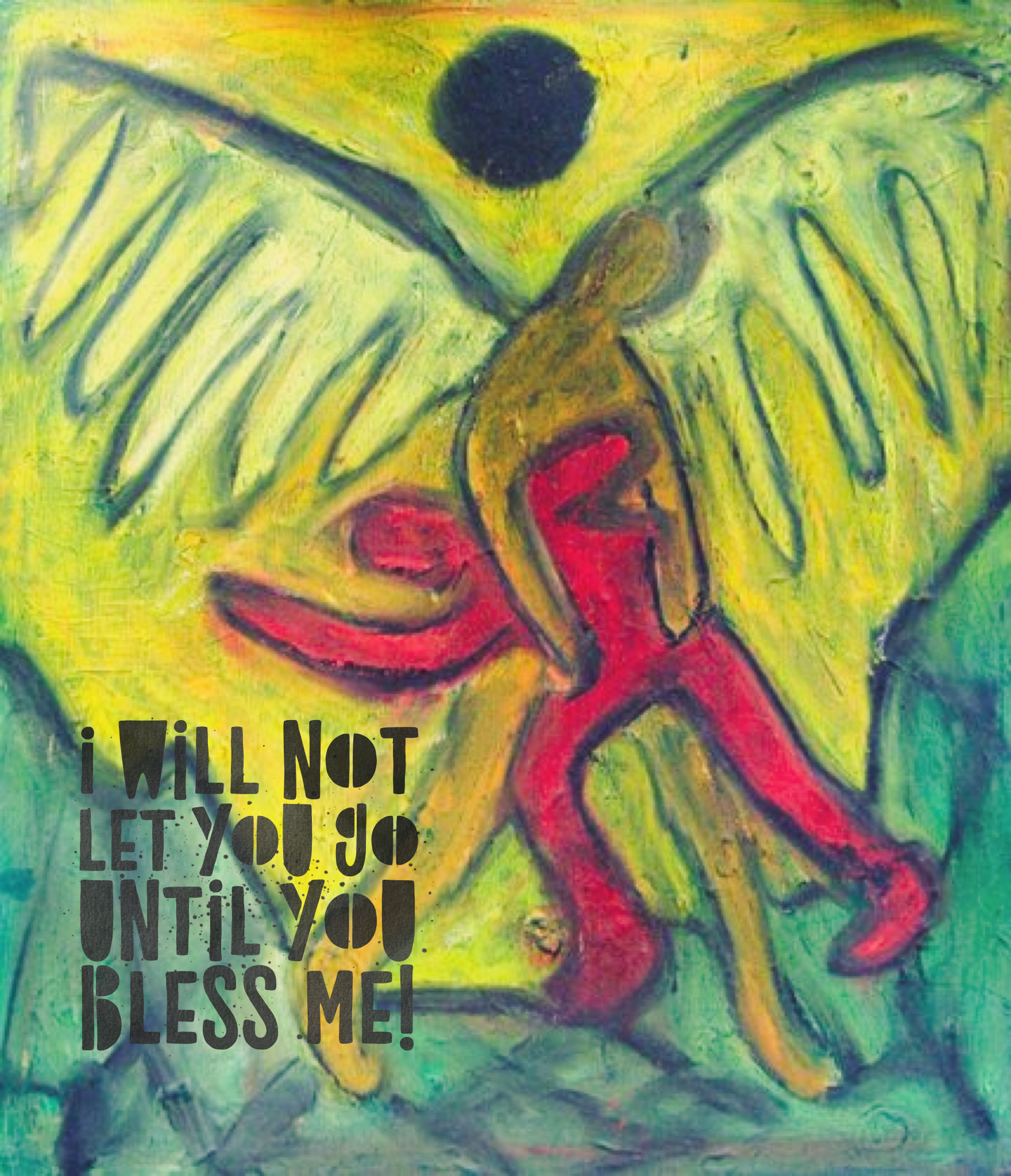
But Jacob replied, “I will not let you go unless you bless me.”
 
The man asked him, “What is your name?”
 
“Jacob,” he answered.
 
Then the man said, “Your name will no longer be Jacob, but Israel, because you have struggled with God and with humans and have overcome.”
 
Jacob said, “Please tell me your name.”
 
But he replied, “Why do you ask my name?” Then he blessed him there.
 
So Jacob called the place Peniel, saying, “It is because I saw God face to face, and yet my life was spared.”
 
The sun rose above him as he passed Peniel, and he was limping because of his hip.

Reflection

This scene is one of my favorite scenes from Scripture. In it, we find a knock-down, drag-out wrestling match between Jacob and this mysterious man. The scene begins with Jacob anxiously preparing for his impending meeting with Esau. Esau, his older twin brother, whom he tricked out of his birthright. Esau, who was understandable angry with his sneaky and dishonest younger twin.

It is a strange scene to imagine – this wrestling that goes from dusk until dawn. This was no polite wrestling match. There were no referees to blow the whistle and call illegal holds. It was an intense match – so much so that Jacob got his hip knocked out of joint. They wrestled, and then they wrestled more. Jacob must have been to the point of exhaustion, and the mysterious man was ready to throw in the towel. He was done.

But then Jacob says, “I will not let you go unless you bless me!”

When we read this story, we see that the blessing actually comes through the knock-down, drag-out wrestling match. Through the exhaustion, through the pain of getting his hip knocked out of joint – through the struggle, Jacob find his blessing.

This story is a good metaphor for how we engage Scripture. We don’t come to it cleanly or plainly. We don’t come to it without struggle. There are some big questions that the Bible raises. If we are really reading it, we find ourselves asking all kinds of questions. Questions relating to the violence and even genocide we find within its pages; questions about the nature of God; questions about good and evil; questions about what it means to live in today’s world. And as we wrestle, we might be overwhelmed. We might get our hips knocked out of place. We might be downright exhausted with all of the questions that we can’t really find satisfactory answers to.

But when we aren’t afraid to wrestle, God gives a blessing. When we aren’t afraid to ask the hard questions, God works through our struggle. As my favorite college professor, Dr. Jeffrey Pugh, always reminded me, “Faith isn’t about finding all of the answers, it’s about learning to live with the questions.”

May you find blessing in the questions.

Ponder

o  What words, phrases, or images from the text speak to you? What thoughts or feelings do they evoke?
o  What have you been wrestling with in Scripture?
o  Where, in your life, have you seen blessing come through struggle?

Challenge

Think about a passage or an idea in the Bible that you have been struggling with. Write about your struggle and the questions it raises. Talk to a friend about it, talk to God about it.

And/or

Notice a family member, friend, or co-worker who has been struggling. Find a way to give them a blessing this week.

Prayer

God, you are ever-present with me, and maybe even especially when I am struggling. Give me the endurance to wrestle faithfully. Give me the courage to ask the hard questions. Give me a heart to trust you when I find answers I don’t like, or even no answers at all. And through it all, may I experience your blessing. In Jesus’ name, I pray. Amen.

– Cindy+