The Reflectionary – Week of January 19, 2020

Epiphany 3

Text: Mark 5:1-20

They went across the lake to the region of the Gerasenes. When Jesus got out of the boat, a man with an impure spirit came from the tombs to meet him. This man lived in the tombs, and no one could bind him anymore, not even with a chain. For he had often been chained hand and foot, but he tore the chains apart and broke the irons on his feet. No one was strong enough to subdue him. Night and day among the tombs and in the hills he would cry out and cut himself with stones.

When he saw Jesus from a distance, he ran and fell on his knees in front of him. He shouted at the top of his voice, “What do you want with me, Jesus, Son of the Most High God? In God’s name don’t torture me!” For Jesus had said to him, “Come out of this man, you impure spirit!” 
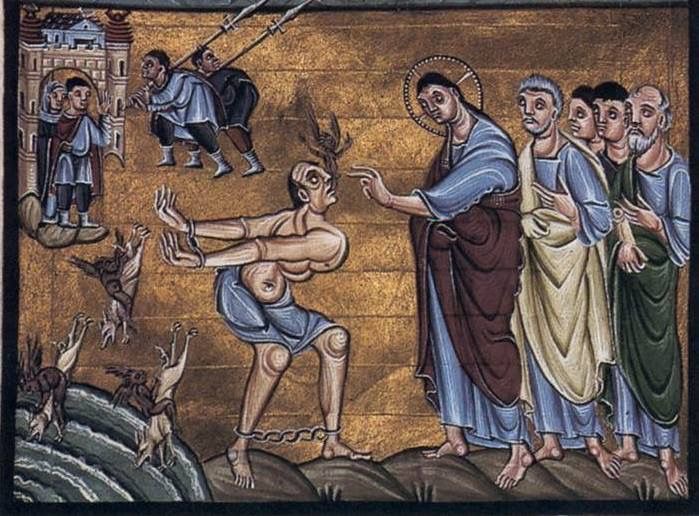
Then Jesus asked him, “What is your name?”

“My name is Legion,” he replied, “for we are many.” And he begged Jesus again and again not to send them out of the area.

A large herd of pigs was feeding on the nearby hillside. The demons begged Jesus, “Send us among the pigs; allow us to go into them.” He gave them permission, and the impure spirits came out and went into the pigs. The herd, about two thousand in number, rushed down the steep bank into the lake and were drowned. 

Those tending the pigs ran off and reported this in the town and countryside, and the people went out to see what had happened. When they came to Jesus, they saw the man who had been possessed by the legion of demons, sitting there, dressed and in his right mind; and they were afraid. Those who had seen it told the people what had happened to the demon-possessed man—and told about the pigs as well. Then the people began to plead with Jesus to leave their region.

As Jesus was getting into the boat, the man who had been demon-possessed begged to go with him. Jesus did not let him, but said, “Go home to your own people and tell them how much the Lord has done for you, and how he has had mercy on you.” So the man went away and began to tell in the Decapolis how much Jesus had done for him. And all the people were amazed. 

Reflection

I love the pathos of this story. The whole scene stirs up a deep sense of fear, of chaos, of compassion. The man that Jesus encounters in the land of the Gerasenes is desperate. He has been so completely affected and taken over by demons that he can’t even live in his community anymore. He’s been driven out of town and his only neighbors are tombstones. And yet, even though he’s utterly alone, his life is anything but quiet and peaceful. His demons torment him day and night. He can’t even really remember who he is or what is happening. He just knows that he is suffering. Yet, even as the demons continue to fight for control, somewhere, deep inside of all of the turmoil and pain, the man sees Jesus and realizes he is his only hope.

I can picture this man. I see his matted hair, his bloody hands, his dirt-covered face, his emaciated body. I see a man who has been so overtaken by forces that are greater than him. No one, and I mean no one, up until this point has any clue what to do with him. He’s a danger to himself and he’s a danger to others. He is one who everybody saw as a completely hopeless case.

And I can also picture Jesus. Rather than standing back in uncertainty, or keeping his distance out of fear or disgust, he sees the man as he runs up. Truly sees. I imagine him locking eyes with the man as he asks him his name. The demons respond, but Jesus is not deterred. Jesus, full of compassion, does not write this man off. Jesus knows who this man is and who he can be. He sends the demons out of the man and into a herd of pigs. Just like that. It’s done.

Notice the response of those who come to see what all of the hubbub was. They see the man who had formerly been possessed, clothed and in his right man. They came right up and started to celebrate, right?

The answer, of course, is, no, they didn’t. In fact, they still kept their distance. The text says it was because they were afraid. What were they afraid of exactly? Perhaps they were afraid that he hadn’t really changed. Maybe they were afraid to look him in the eye or talk to him after all of the things that had conspired between him and his community. Possibly they were afraid that Jesus might intrude on their lives in the same way, or that he might see the other demons that they wrestled with in less obvious ways. In any case, their response was not one of celebration, it was one of distance.

I think the man who had been healed noticed this, and it may have been part of the reason he asked to go with Jesus. It certainly would have been easier for everyone if he had done so. Instead, Jesus commands him to return home. In doing so, Jesus taught the man and his community, and he teaches us, that true healing often includes the restoration of relationship.

Two healings occurred that day in the graveyard – the man was delivered from his demons, and then he was restored to his community. As we contemplate this encounter between Jesus, the Gerasene demoniac, and the surrounding crowds, Jesus reminds us that there are many ways in which he can bring healing.

Ponder

o   What words, phrases, or images from the text speak to you? What thoughts or feelings do they evoke?
o   Where do you see yourself in this story? With the man among the tombs? With the crowds? Tending the pigs that come to an abrupt end? Somewhere else?
o   Where in your life do you need to find restoration or reconnection with another?

Challenge

Consider a relationship in your life that might need some healing. How might you reach out to encourage reconnection? Pray about it. If you feel ready to act, do so.

And/or

Think of a time when God healed you or someone you love. Remember, healing doesn’t always mean physical healing. It can be emotional, spiritual, or relational as well. Write a prayer of thanksgiving for what God has done.

Prayer

God, you are always ready to see me, and to heal me. May I fall down at your feet like the man among the tombs, recognizing that you are my hope and my healer. Restore me, reconnect me, reveal to me the ways that you are working. Free me from the demons I wrestle with. Give me clarity of mind and peace in chaos. In Jesus’ name I pray. Amen.

– Cindy+
The Reflectionary – Week of January 12, 2020

Epiphany 2

Text: Mark 4:1-34

Again Jesus began to teach by the lake. The crowd that gathered around him was so large that he got into a boat and sat in it out on the lake, while all the people were along the shore at the water’s edge. He taught them many things by parables, and in his teaching said: “Listen! A farmer went out to sow his seed. As he was scattering the seed, some fell along the path, and the birds came and ate it up. Some fell on rocky places, where it did not have much soil. It sprang up quickly, because the soil was shallow. But when the sun came up, the plants were scorched, and they withered because they had no root. Other seed fell among thorns, which grew up and choked the plants, so that they did not bear grain. Still other seed fell on good soil. It came up, grew and produced a crop, some multiplying thirty, some sixty, some a hundred times.” 

Then Jesus said, “Whoever has ears to hear, let them hear.”

When he was alone, the Twelve and the others around him asked him about the parables. He told them, “The secret of the kingdom of God has been given to you. But to those on the outside everything is said in parables so that, 

“‘they may be ever seeing but never perceiving,

    and ever hearing but never understanding;

otherwise they might turn and be forgiven!’”

Then Jesus said to them, “Don’t you understand this parable? How then will you understand any parable? The farmer sows the word. Some people are like seed along the path, where the word is sown. As soon as they hear it, Satan comes and takes away the word that was sown in them. Others, like seed sown on rocky places, hear the word and at once receive it with joy. But since they have no root, they last only a short time. When trouble or persecution comes because of the word, they quickly fall away. Still others, like seed sown among thorns, hear the word; but the worries of this life, the deceitfulness of wealth and the desires for other things come in and choke the word, making it unfruitful. Others, like seed sown on good soil, hear the word, accept it, and produce a crop—some thirty, some sixty, some a hundred times what was sown.” 

He said to them, “Do you bring in a lamp to put it under a bowl or a bed? Instead, don’t you put it on its stand? For whatever is hidden is meant to be disclosed, and whatever is concealed is meant to be brought out into the open. If anyone has ears to hear, let them hear.” 

“Consider carefully what you hear,” he continued. “With the measure you use, it will be measured to you—and even more. Whoever has will be given more; whoever does not have, even what they have will be taken from them.” 

He also said, “This is what the kingdom of God is like. A man scatters seed on the ground. Night and day, whether he sleeps or gets up, the seed sprouts and grows, though he does not know how. All by itself the soil produces grain—first the stalk, then the head, then the full kernel in the head. As soon as the grain is ripe, he puts the sickle to it, because the harvest has come.” 

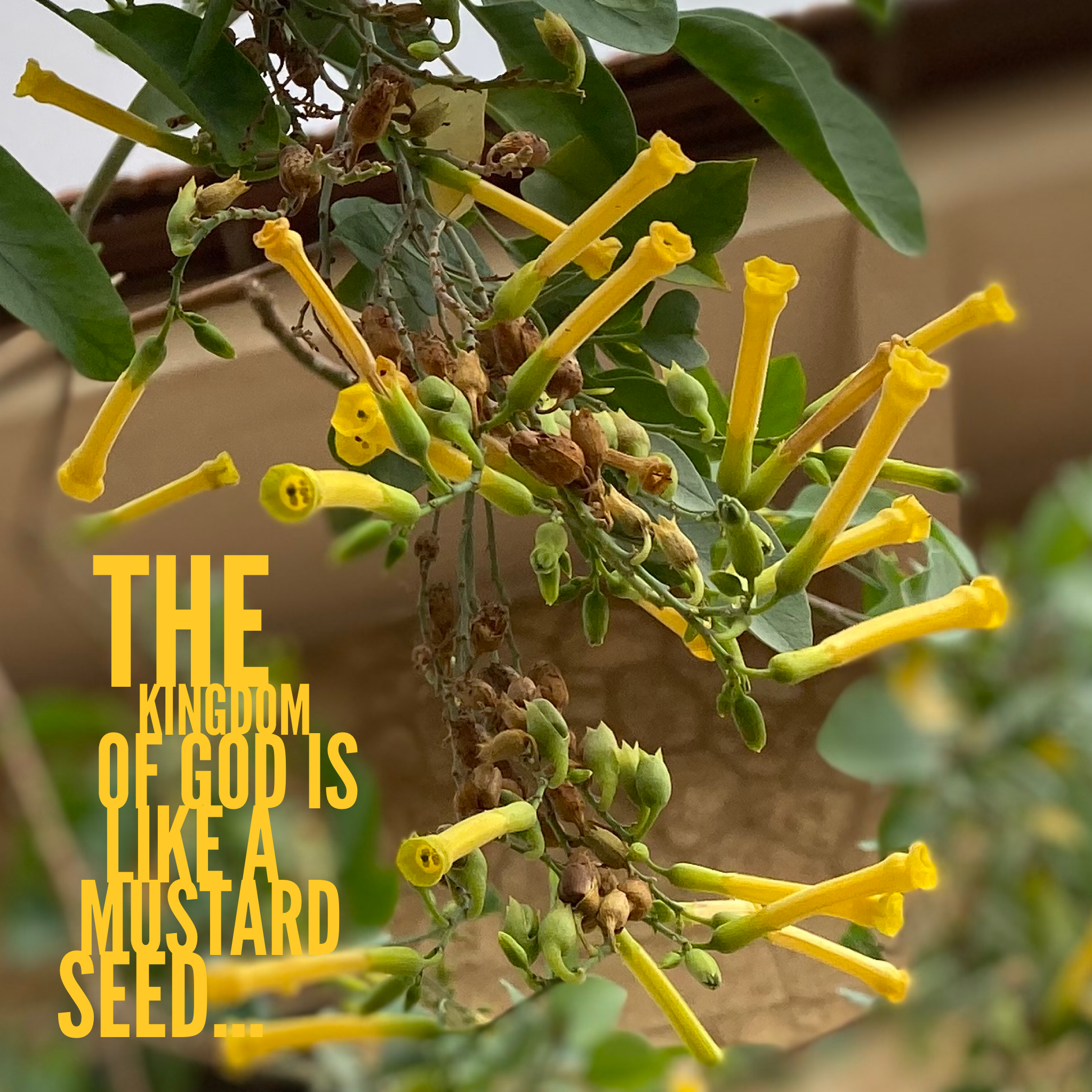
Again he said, “What shall we say the kingdom of God is like, or what parable shall we use to describe it? It is like a mustard seed, which is the smallest of all seeds on earth. Yet when planted, it grows and becomes the largest of all garden plants, with such big branches that the birds can perch in its shade.”

With many similar parables Jesus spoke the word to them, as much as they could understand. He did not say anything to them without using a parable. But when he was alone with his own disciples, he explained everything.

Reflection

Today, I am reading these passages against the backdrop of current events. Last week, our President unilaterally ordered a military strike with the intent to assassinate Maj. Gen. Qassem Soleimani of Iran. The strike succeeded and Soleimani was killed. The fallout has been swift – tensions have worsened, some retaliation has already occurred, and it looks like we might be sliding toward all-out war with Iran.

For years, as a Christian, I have wrestled with whether or not war is ever justifiable. Sometimes I fall closer to the understanding that in very specific and rare instances, war can be justified (as long as it adheres to the strict principles of just war theory), other times I buck against even the idea of just war. In an ideal world, we would never have to ask men and women to put on the uniform and sacrificially serve in the military. I know we do not live in an ideal world, but the real world. We live in the tension between what God desires and of what is. The question of the necessity of war is one I will continue to wrestle with for my whole life.

As I read this passage, this time, I couldn’t help but think about the words of Isaiah 2:4: “He will judge between the nations and will settle disputes for many peoples. They will beat their swords into plowshares and their spears into pruning hooks. Nation will not take up sword against nation, nor will they train for war anymore.” Isaiah paints a picture of the coming Kingdom of God that indicates a shift away from war and violence and a shift toward agrarian life. I find it significant that so often, when Jesus speaks in parables about the Kingdom of God, like he does in this week’s text, he uses agrarian images. He uses images of cultivation. Of growth. Of life.

We live in a culture of death. Violence, fear, and hatred permeate our society. They permeate our world. It has become normal, justifiable and even in moments, glorifiable, to wage war or inflict violence upon the one deemed as an enemy. I cannot pretend to have figured out what we do about evil and suffering in the world, but I also cannot help but think that when Jesus speaks in parables about God’s Kingdom, he speaks about cultivation, about growth, and about nurturing life for a reason.

In three of these short parables, Jesus uses the image of the seed, scattered or sown in the ground, as a way of talking about what the Kingdom of God is like. In each, something grows, and that which grows provides nourishment or nurture for someone or something else (other people, birds, etc). What does it mean for us to be the good seed that gets spread on the ground? What does it mean for us to be those cultivated for and those cultivating God’s kingdom?

We live in a complicated world, to be sure, and I certainly don’t want to suggest that Christians should do nothing in the face of evil, but I do wonder what it would mean to seek to live out that shift that Isaiah indicates and that Jesus echoes in his parables. What might it look like for our swords to be beat into plowshares? What might it mean to “train for war no more?” What would it look like for Christians to be trained and cultivated in the ways of peace, in ways that provide nurture and nourishment for all? What could it be like to embody a culture of life rather than one of death? I ask all of these questions not because I have answers to them, but because I wrestle with them.

Jesus says the Kingdom of God is like a mustard seed – the smallest of seeds. It’s tiny. It doesn’t seem like it will amount to much or make a difference. But when that tiny seed is cultivated, it grows and provides nurture. It lends itself to the life and well-being of God’s creatures. What seeds of life and peace might God be wanting to nurture in you today?

Perhaps we leave the text today with more questions than we had before we read it. Perhaps we feel discomfort after reflecting. May the questions and discomfort lead you to a holy wrestling that move you along the path of wisdom and peace.

Ponder

o   What words, phrases, or images from the text speak to you? What thoughts or feelings do they evoke?
o   Today’s world is full of violence and unrest. Where do you find peace and hope?
o   What might God be trying to cultivate in you right now?

Challenge

Our world needs prayer. Our leaders need prayer. Our country needs prayer. Spend a significant amount of time praying for wisdom and peace. Journal your prayers, speak them aloud, put them on notes around the house. Ask God to guide you in the ways of Jesus.

And/or

It’s still winter so it might be hard to get out in the dirt and work with your hands, but if you can, spend some time nurturing things that grow from the ground. It might be tending to houseplants or planting a windowsill herb garden, or maybe sitting down and planning what your will grow this spring. As you do, consider what God might be trying to grow in you.

Prayer

God, you are a God of life. Cultivate in my heart your goodness. Train me in the ways of peace. Sow in me the good seeds of your Kingdom that I might be an instrument of nurture for others. In Jesus’ name I pray. Amen.

-Cindy+

The Reflectionary – Week of January 5, 2020

Epiphany 1

Text: Mark 2:1-22

A few days later, when Jesus again entered Capernaum, the people heard that he had come home. They gathered in such large numbers that there was no room left, not even outside the door, and he preached the word to them. Some men came, bringing to him a paralyzed man, carried by four of them. Since they could not get him to Jesus because of the crowd, they made an opening in the roof above Jesus by digging through it and then lowered the mat the man was lying on. When Jesus saw their faith, he said to the paralyzed man, “Son, your sins are forgiven.”

 Now some teachers of the law were sitting there, thinking to themselves, “Why does this fellow talk like that? He’s blaspheming! Who can forgive sins but God alone?” 

Immediately Jesus knew in his spirit that this was what they were thinking in their hearts, and he said to them, “Why are you thinking these things? Which is easier: to say to this paralyzed man, ‘Your sins are forgiven,’ or to say, ‘Get up, take your mat and walk’? But I want you to know that the Son of Man has authority on earth to forgive sins.” So he said to the man, “I tell you, get up, take your mat and go home.” He got up, took his mat and walked out in full view of them all. This amazed everyone and they praised God, saying, “We have never seen anything like this!”

Once again Jesus went out beside the lake. A large crowd came to him, and he began to teach them. As he walked along, he saw Levi son of Alphaeus sitting at the tax collector’s booth. “Follow me,” Jesus told him, and Levi got up and followed him.

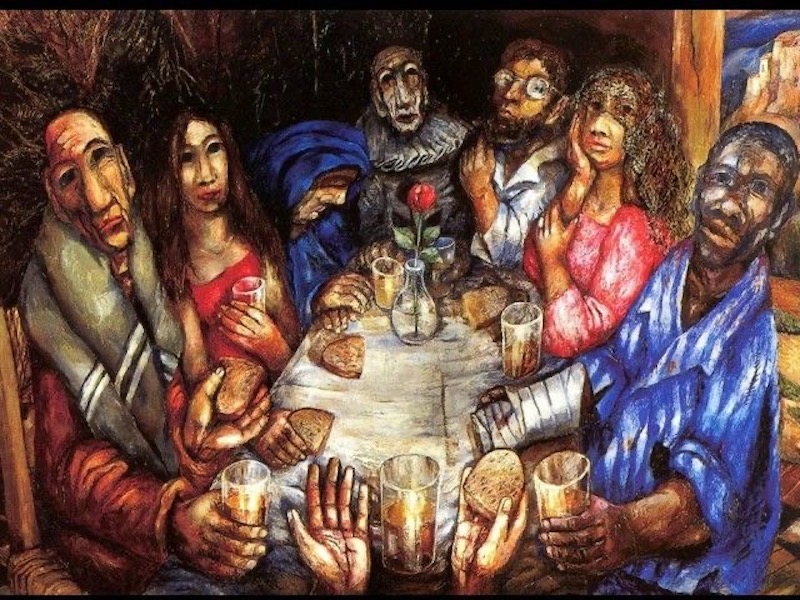
Painting by Fr. Sieger Koder

While Jesus was having dinner at Levi’s house, many tax collectors and sinners were eating with him and his disciples, for there were many who followed him. When the teachers of the law who were Pharisees saw him eating with the sinners and tax collectors, they asked his disciples: “Why does he eat with tax collectors and sinners?” 

On hearing this, Jesus said to them, “It is not the healthy who need a doctor, but the sick. I have not come to call the righteous, but sinners.”

Now John’s disciples and the Pharisees were fasting. Some people came and asked Jesus, “How is it that John’s disciples and the disciples of the Pharisees are fasting, but yours are not?” 

Jesus answered, “How can the guests of the bridegroom fast while he is with them? They cannot, so long as they have him with them. But the time will come when the bridegroom will be taken from them, and on that day they will fast. 

“No one sews a patch of unshrunk cloth on an old garment. Otherwise, the new piece will pull away from the old, making the tear worse. And no one pours new wine into old wineskins. Otherwise, the wine will burst the skins, and both the wine and the wineskins will be ruined. No, they pour new wine into new wineskins.”

Reflection

In this week’s text, we find Jesus in three different scenes: one healing a man who is paralyzed, one sitting at Levi’s dinner table, and one where Jesus is questioned as to why he is not fasting when everyone else is. If I had to name this passage like an episode of the show Friends, I’d call it, “The One Where Jesus Flips Expectations.”

The first story begins with a familiar scene – many gathered around Jesus as he teaches in a home. People have come from all around town and the surrounding countryside to learn from this teacher and healer. It’s no surprise that people are clamoring to get close to Jesus to experience his miraculous healing for themselves. That’s exactly what four men do when they bring a paralyzed man to Jesus. But it’s so crowded they can’t even get in the house. So they do the best thing they can think of – they climb up onto the roof, pull away some of the thatching, and they lower their friend down from the roof to the space right in front of Jesus. Their persistence and faith are certainly central aspects of this story. In this moment though, I want to consider the surprising way that Jesus responds.

Expectations were such that Jesus would, of course, immediately heal this man of his paralysis. Instead, Jesus responds in an unexpected way. He says, “Son, your sins are forgiven.” Jesus, say what? Your sins are forgiven? First of all, that wasn’t even what they were asking for. Second of all, how can Jesus even do that? Isn’t God the only one able to forgive sin? (Which, of course, is the whole point of Jesus doing such a thing – to reveal that he’s more than just a healer; he was, in fact, God in the flesh.) Receiving forgiveness of sin was not what anyone was expecting from Jesus. The boundaries between God and humanity were being torn down in this encounter, and those who questioned Jesus on this knew it.

The second scene, too, flips expectations in their head. Jesus is sitting down to dinner with a number of people. That part is not surprising. But where is Jesus eating? He’s eating at Levi’s house. A tax collector. A tax collector was someone who was seen as a corrupt extortionist. A Jewish tax collector was those things and more – he was a betrayer of his people by working for Rome, the empire of oppression. Jesus is eating in such a man’s house, along with other sinners. The Pharisees ask themselves, “what in the world is Jesus doing? How could he eat with such unrighteous people?” As they voice their question, Jesus responds, “It’s not the healthy people who need a doctor, but the sick.” Again, not what they were expecting from Jesus.

And then there’s the third scene, which is little more than Jesus giving a semi-cryptic response to a few people who came to ask him why he and his disciples were not fasting when both John and the Pharisees were. He talks about a present bridegroom, unshrunk cloth, and wineskins, and in each metaphor, Jesus seems to be telling his listeners that he is doing something different. He’s breaking from the norm. Something new is taking place.

In this single chapter of Mark’s gospel, Jesus is clearly different than what many expected him to be. They don’t yet truly understand, but Jesus is beginning to show them that he is one to flip expectations. And isn’t that what God does? Any time we try to put God in our own box or conform him to our image, God breaks out and says, nope, that’s not who I am – let me show you a little bit more.

It can be jarring when our picture of God is stretched, or when our understanding of how we practice faith is challenged. Those who were around Jesus struggled to understand what he was doing and saying. The Pharisees and many other devout people really did not know how to handle Jesus. While there were, certainly, some Pharisees who were hypocritical, judgmental, or power-hungry, on the whole, I think they were largely a group of pious people who were doing their best to be faithful in keeping the covenant with God. And yet, Jesus challenges them. Jesus challenges us today too. Jesus challenges pious Christians who are just doing our best to be faithful in keeping the covenant with God.

If this gospel text reminds us of anything, it is this: Jesus will constantly surprise us and challenge our expectations of him. Are you willing to encounter him in new and unexpected ways?

Ponder

o   What words, phrases, or images from the text speak to you? What thoughts or feelings do they evoke?
o   How has Jesus surprised you?
o   Where have you been stretched in your faith?

Challenge

Jesus had a habit of going and hanging out with people who were different or excluded. He challenged categories left and right. Consider a group of people who might be different than you. What might you be able to do to bring yourself into a closer relationship with them? Perhaps it could mean going and sitting down to share a meal with someone at Manna Meal in downtown Charleston or volunteering with a recovery home. Maybe you could ask to visit with folks from our local mosque or from the synagogue or temple downtown. (And if you need help in making connection with any of those communities, please let Pastor Cindy know)

And/or

Jesus likes to sit down at the table with people. It is one of the main ways that he builds relationships with others in the New Testament. Make a plan to have a meal with someone – a coworker, a neighbor, someone you may not normally get to spend much time with. Have them over for dinner, or go out to eat together.

Prayer

God, you always flip my expectations. You show up in places I’m not expecting or looking. Help me to see you wherever you are and to also see whomever you are with. Do something new within me, that I might be a new wineskin, ready to receive your transforming grace. In Jesus’ name I pray, Amen.

-Cindy+