The Reflectionary – Week of September 15, 2019

Text: Exodus 3:1-15

Now Moses was tending the flock of Jethro his father-in-law, the priest of Midian, and he led the flock to the far side of the wilderness and came to Horeb, the mountain of God. There the angel of the Lord appeared to him in flames of fire from within a bush. Moses saw that though the bush was on fire it did not burn up. So Moses thought, “I will go over and see this strange sight—why the bush does not burn up.”

When the Lord saw that he had gone over to look, God called to him from within the bush, “Moses! Moses!”

And Moses said, “Here I am.”

“Do not come any closer,” God said. “Take off your sandals, for the place where you are standing is holy ground.” Then he said, “I am the God of your father, the God of Abraham, the God of Isaac and the God of Jacob.” At this, Moses hid his face, because he was afraid to look at God.

The Lord said, “I have indeed seen the misery of my people in Egypt. I have heard them crying out because of their slave drivers, and I am concerned about their suffering. So I have come down to rescue them from the hand of the Egyptians and to bring them up out of that land into a good and spacious land, a land flowing with milk and honey—the home of the Canaanites, Hittites, Amorites, Perizzites, Hivites and Jebusites. And now the cry of the Israelites has reached me, and I have seen the way the Egyptians are oppressing them. So now, go. I am sending you to Pharaoh to bring my people the Israelites out of Egypt.”

But Moses said to God, “Who am I that I should go to Pharaoh and bring the Israelites out of Egypt?”

And God said, “I will be with you. And this will be the sign to you that it is I who have sent you: When you have brought the people out of Egypt, you will worship God on this mountain.”

Moses said to God, “Suppose I go to the Israelites and say to them, ‘The God of your fathers has sent me to you,’ and they ask me, ‘What is his name?’ Then what shall I tell them?”
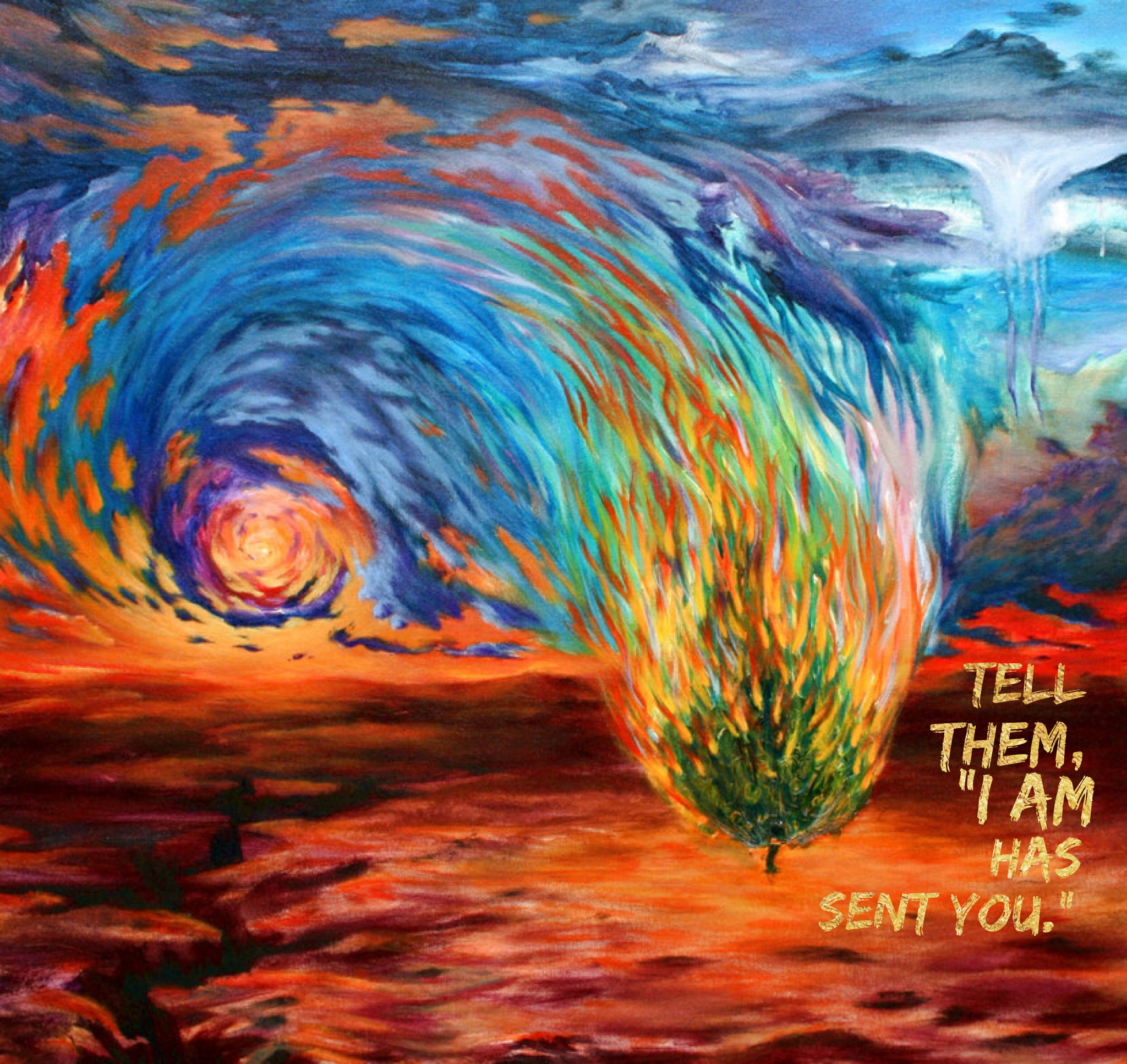
God said to Moses, “I Am who I Am. This is what you are to say to the Israelites: ‘I Am has sent me to you.’”

God also said to Moses, “Say to the Israelites, ‘The Lord, the God of your fathers—the God of Abraham, the God of Isaac and the God of Jacob—has sent me to you.’

“This is my name forever,the name you shall call mefrom generation to generation.”

Reflection

This moment where Moses comes upon the burning bush is one of the most pivotal moments in all of the Bible. While God had appeared and made a covenant with others before now, here is where God reveals God’s own name.

Moses has already been through much. He’d already been sent by his mother down the river in an effort to save him. He’d already been brought into Pharaoh’s household and raised by Pharaoh’s daughter. He’d already fled after killing an Egyptian task-master. He’d already married and was living as a shepherd in the land of Midian, watching the oppression from his people, the Israelites, from afar.

Moses was one who had been continually driven away from home. He was driven away first from his mother, then from his adoptive family, then from his people. When Moses comes across the burning bush, the concept of “home” was probably one that was blurry at best for him.

And then Moses hears the voice: “Moses! Moses! Take off your sandals!”

God tells him to do so because he is standing on holy ground. Taking off the sandals, is, after all, a sign of respect. But God is communicating something else as well in this command. Taking off the shoes is also a sign of being welcomed home.

Many people have a “no shoes in the house” rule. When you enter their home, you take your shoes off and you leave them by the door. While for some, this might be about keeping the carpet clean, for some, it is also a way of saying, “make yourself at home!”

When God tells Moses to take off his shoes, God is saying to him, “Welcome home! Kick off your shoes! This is where you are supposed to be!”

YHWH is the revelation of the Divine Name. It means something akin to “I Am who I Am” or “I Will Be who I Will Be.” In the revelation of God’s own name to Moses, God says, “I Am with you.” God shows Moses that the God who was, and is, and will be is the one in whom he can find his true understanding of home.

And yet, even as God calls Moses to the comfort of knowing to whom he truly belonged, he also called Moses to the task of his lifetime – leading his people out of Egypt and the bonds of slavery and oppression. Moses was given his home, but he was also given his life’s mission. Belonging to God didn’t mean a life of ease or comfort. It meant a life of fighting against injustice. It meant a life of constantly being threatened by the powers that be. It meant a life of wilderness wanderings, deep frustration, and hardship.

Home with God doesn’t always mean rainbows and unicorns. It doesn’t always mean comfort and prosperity. If Moses’ life shows us anything, it is that the opposite is more likely true. And yet… when God reveals God’s self to us and invites us home, nothing else can compare.

Moses could not have anticipated what would happen that day as he was tending his father-in-law’s sheep. He could not have known what God would show him. He could not have known what God would give him, in the revelation of the Divine Name.

When God reveals the Divine Name to Moses, God also reveals Moses’ true identity, his true purpose, his true home. It is in God and among God’s people. May God reveal the same to us.

Ponder

o  What words, phrases, or images from the text speak to you? What thoughts or feelings do they evoke?
o  What is “home” to you? What qualities does it have?
o  When have you experienced true belonging? How can you help others experience that, especially within your community of faith?

Challenge

Consider someone who is a part of your family, whether it is by blood, by love, or by faith. Think of something you can do to help them feel a deeper sense of belonging this week, and then do it.

and/or

Maybe you know someone who isn’t living at home right now. It could be a college student, it could be someone in the hospital, it could be someone who has moved to assisted living. Call, visit, or send them something to help make their space feel a little bit more like home.

Prayer

Holy God, you call me to remove my shoes – to make myself at home in you and among your people. You are the God who IS. You will always be with me. Through the peace of knowing that I will always belong to you, lead me out to do your work. Give me clarity in your mission and purpose for me, and give me the strength and courage to live it. In Jesus’ name, I pray. Amen.

-Cindy+
The Reflectionary – Week of September 8, 2019

Text: Genesis 32:9-13; 22-31

Then Jacob prayed, “O God of my father Abraham, God of my father Isaac, Lord, you who said to me, ‘Go back to your country and your relatives, and I will make you prosper,’ I am unworthy of all the kindness and faithfulness you have shown your servant. I had only my staff when I crossed this Jordan, but now I have become two camps. Save me, I pray, from the hand of my brother Esau, for I am afraid he will come and attack me, and also the mothers with their children. But you have said, ‘I will surely make you prosper and will make your descendants like the sand of the sea, which cannot be counted.’”
 
He spent the night there, and from what he had with him he selected a gift for his brother Esau.
_________
 
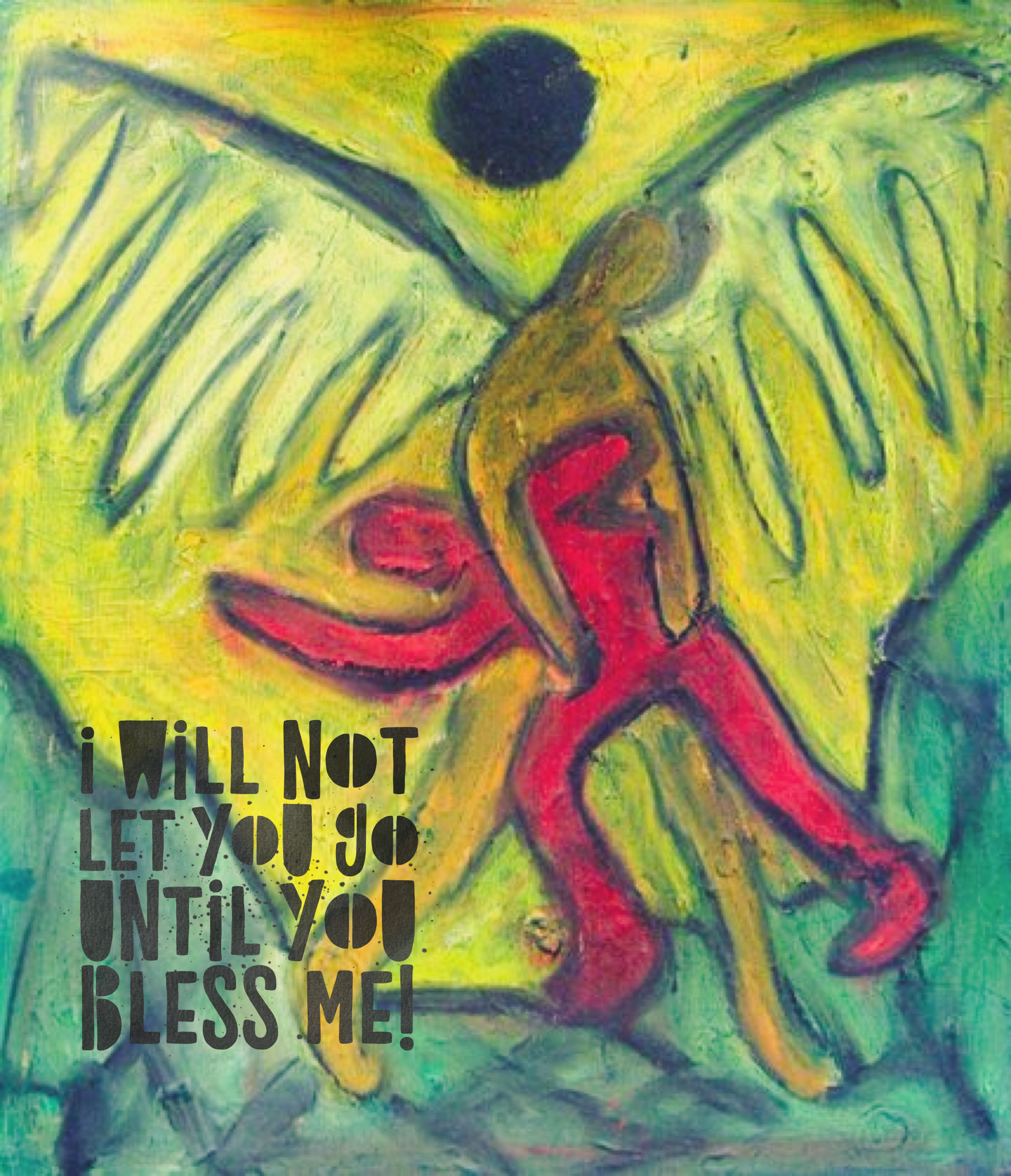
So Jacob was left alone, and a man wrestled with him till daybreak. When the man saw that he could not overpower him, he touched the socket of Jacob’s hip so that his hip was wrenched as he wrestled with the man. Then the man said, “Let me go, for it is daybreak.”
 
But Jacob replied, “I will not let you go unless you bless me.”
 
The man asked him, “What is your name?”
 
“Jacob,” he answered.
 
Then the man said, “Your name will no longer be Jacob, but Israel, because you have struggled with God and with humans and have overcome.”
 
Jacob said, “Please tell me your name.”
 
But he replied, “Why do you ask my name?” Then he blessed him there.
 
So Jacob called the place Peniel, saying, “It is because I saw God face to face, and yet my life was spared.”
 
The sun rose above him as he passed Peniel, and he was limping because of his hip.

Reflection

This scene is one of my favorite scenes from Scripture. In it, we find a knock-down, drag-out wrestling match between Jacob and this mysterious man. The scene begins with Jacob anxiously preparing for his impending meeting with Esau. Esau, his older twin brother, whom he tricked out of his birthright. Esau, who was understandable angry with his sneaky and dishonest younger twin.

It is a strange scene to imagine – this wrestling that goes from dusk until dawn. This was no polite wrestling match. There were no referees to blow the whistle and call illegal holds. It was an intense match – so much so that Jacob got his hip knocked out of joint. They wrestled, and then they wrestled more. Jacob must have been to the point of exhaustion, and the mysterious man was ready to throw in the towel. He was done.

But then Jacob says, “I will not let you go unless you bless me!”

When we read this story, we see that the blessing actually comes through the knock-down, drag-out wrestling match. Through the exhaustion, through the pain of getting his hip knocked out of joint – through the struggle, Jacob find his blessing.

This story is a good metaphor for how we engage Scripture. We don’t come to it cleanly or plainly. We don’t come to it without struggle. There are some big questions that the Bible raises. If we are really reading it, we find ourselves asking all kinds of questions. Questions relating to the violence and even genocide we find within its pages; questions about the nature of God; questions about good and evil; questions about what it means to live in today’s world. And as we wrestle, we might be overwhelmed. We might get our hips knocked out of place. We might be downright exhausted with all of the questions that we can’t really find satisfactory answers to.

But when we aren’t afraid to wrestle, God gives a blessing. When we aren’t afraid to ask the hard questions, God works through our struggle. As my favorite college professor, Dr. Jeffrey Pugh, always reminded me, “Faith isn’t about finding all of the answers, it’s about learning to live with the questions.”

May you find blessing in the questions.

Ponder

o  What words, phrases, or images from the text speak to you? What thoughts or feelings do they evoke?
o  What have you been wrestling with in Scripture?
o  Where, in your life, have you seen blessing come through struggle?

Challenge

Think about a passage or an idea in the Bible that you have been struggling with. Write about your struggle and the questions it raises. Talk to a friend about it, talk to God about it.

And/or

Notice a family member, friend, or co-worker who has been struggling. Find a way to give them a blessing this week.

Prayer

God, you are ever-present with me, and maybe even especially when I am struggling. Give me the endurance to wrestle faithfully. Give me the courage to ask the hard questions. Give me a heart to trust you when I find answers I don’t like, or even no answers at all. And through it all, may I experience your blessing. In Jesus’ name, I pray. Amen.

– Cindy+

The Reflectionary – Week of September 1, 2019

Text: Genesis 18:1-15; 21:1-7

The Lord appeared to Abraham near the great trees of Mamre while he was sitting at the entrance to his tent in the heat of the day. Abraham looked up and saw three men standing nearby. When he saw them, he hurried from the entrance of his tent to meet them and bowed low to the ground.
 

Abraham and the Three Angels by Marc Chagall

He said, “If I have found favor in your eyes, my lord, do not pass your servant by. Let a little water be brought, and then you may all wash your feet and rest under this tree. Let me get you something to eat, so you can be refreshed and then go on your way—now that you have come to your servant.”
 
“Very well,” they answered, “do as you say.”
 
So Abraham hurried into the tent to Sarah. “Quick,” he said, “get three seahs of the finest flour and knead it and bake some bread.”
 
Then he ran to the herd and selected a choice, tender calf and gave it to a servant, who hurried to prepare it. He then brought some curds and milk and the calf that had been prepared, and set these before them. While they ate, he stood near them under a tree.
 
“Where is your wife Sarah?” they asked him.
 
“There, in the tent,” he said.
 
Then one of them said, “I will surely return to you about this time next year, and Sarah your wife will have a son.”
 
Now Sarah was listening at the entrance to the tent, which was behind him. Abraham and Sarah were already very old, and Sarah was past the age of childbearing. So Sarah laughed to herself as she thought, “After I am worn out and my lord is old, will I now have this pleasure?”
 
Then the Lord said to Abraham, “Why did Sarah laugh and say, ‘Will I really have a child, now that I am old?’ Is anything too hard for the Lord? I will return to you at the appointed time next year, and Sarah will have a son.”
 
Sarah was afraid, so she lied and said, “I did not laugh.”
 
But he said, “Yes, you did laugh.”
_________
 
Now the Lord was gracious to Sarah as he had said, and the Lord did for Sarah what he had promised. Sarah became pregnant and bore a son to Abraham in his old age, at the very time God had promised him. Abraham gave the name Isaac to the son Sarah bore him. When his son Isaac was eight days old, Abraham circumcised him, as God commanded him. Abraham was a hundred years old when his son Isaac was born to him.
 
Sarah said, “God has brought me laughter, and everyone who hears about this will laugh with me.” And she added, “Who would have said to Abraham that Sarah would nurse children? Yet I have borne him a son in his old age.”

Reflection

Have you ever had someone tell you something, and your first thought was, “Yeah, right, that’ll happen when pigs fly!”? That was exactly Sarah’s reaction when the visitor told her that she would bear a son. She was well past her child-bearing years, and if she wasn’t able to get pregnant during her “fertile” years, how in the world was she going to get pregnant now?

This is not the first time that Abraham and Sarah have heard this promise. In Genesis 15, God tells Abraham that he will have a son of his own flesh and that his offspring will be as numerous as the stars. Abraham and Sarah don’t have any inkling how this will actually happen as they are both old and Sarah is past child-bearing years. Sarah comes up with her own plan to make God’s plan work – Abraham will sleep with Sarah’s slave, Hagar, get her pregnant, and bear a son of his own flesh through her (and let’s not even get started on how messed up that whole situation is). Abraham agrees, and Sarah’s manipulative and abusive plan for Hagar achieves her desired results. Hagar bears a son named Ishmael. Much familial abuse and dysfunction ensues.

Now, some years have passed. Ishmael is growing, and God speaks to Abraham again, telling him that Sarah, specifically, will bear him a son, to be named Isaac. God further clarifies the nature of God’s covenant with Abraham and future generations of his family, and Abraham and all of the men and boys belonging to Abraham’s household are circumcised as a sign of that covenant. Laughter and disbelief are Abraham’s response to God’s promise about Sarah’s impending pregnancy.

And yet – despite their disbelief, despite their laughter, God brings the plan about. Not as Sarah or Abraham tried to orchestrate it (which led to much strife and abuse), but as God orchestrated it. Sarah does indeed bear a child well past her child-bearing years, and her laughter of derision and disbelief turns to the laughter of sheer joy and the overwhelming nature of God’s grace.

Did Abraham and Sarah deserve this gift? My own personal impulse, after what they did to Hagar and Ishmael, is to say, “No, absolutely not!” But that’s the thing about God’s grace. It is not dependent upon “deserving” it. God’s grace is a free, and undeserved gift.

Often, as Christians, we are tempted to restrict the idea of grace to the New Testament – “That’s something Jesus brought us,” we say. And yet, when we look at this story, among many others in the Hebrew Bible, aka the Old Testament, we find that God’s grace has actually been present all along. May we all catch glimpses of God’s grace in unsuspected places!

Ponder

o  What words, phrases, or images from the text speak to you? What thoughts or feelings do they evoke?
o   Where in your life have you seen God accomplish an “impossible” task?
o   Who might you have you hurt in the name of accomplishing your own plans?
o   Where have you seen God’s grace at work this past week?

Challenge

Each evening this week, before you go to bed, take a few moments to pause, reflecting back over your day, and identify the moments or experiences where you have seen God’s grace. Give thanks to God for those moments.

And/or

Reach out to someone you have hurt. Talk with them openly and honestly. Repent. Seek forgiveness. Accept their response, whatever it may be.

Prayer

Surprising God, you are always on the move. Thank you for the ways that you show up when I am least expecting it. Forgive me for the ways that I try to manipulate your plans for me. Forgive me for the times where I fail to trust you. Give me the strength to make things right with those I have hurt, with those I have used, and with those I have cast aside. May your grace be continually at work in my heart, not because I deserve it, but because you desire it. Turn my derision and disbelief into laughter and joy. Fill me with your Spirit and your love. In Jesus’ name, I pray. Amen.

– Cindy+