The Reflectionary – Week of October 27, 2019

Text: 1 Kings 18:17-39

When he [King Ahab] saw Elijah, he said to him, “Is that you, you troubler of Israel?”

“I have not made trouble for Israel,” Elijah replied. “But you and your father’s family have. You have abandoned the Lord’s commands and have followed the Baals. Now summon the people from all over Israel to meet me on Mount Carmel. And bring the four hundred and fifty prophets of Baal and the four hundred prophets of Asherah, who eat at Jezebel’s table.”

 So Ahab sent word throughout all Israel and assembled the prophets on Mount Carmel. Elijah went before the people and said, “How long will you waver between two opinions? If the Lord is God, follow him; but if Baal is God, follow him.”

But the people said nothing.

Then Elijah said to them, “I am the only one of the Lord’s prophets left, but Baal has four hundred and fifty prophets. Get two bulls for us. Let Baal’s prophets choose one for themselves, and let them cut it into pieces and put it on the wood but not set fire to it. I will prepare the other bull and put it on the wood but not set fire to it. Then you call on the name of your god, and I will call on the name of the Lord. The god who answers by fire—he is God.”

Then all the people said, “What you say is good.” 

Elijah said to the prophets of Baal, “Choose one of the bulls and prepare it first, since there are so many of you. Call on the name of your god, but do not light the fire.” So they took the bull given them and prepared it. 

Then they called on the name of Baal from morning till noon. “Baal, answer us!” they shouted. But there was no response; no one answered. And they danced around the altar they had made. 

At noon Elijah began to taunt them. “Shout louder!” he said. “Surely he is a god! Perhaps he is deep in thought, or busy, or traveling. Maybe he is sleeping and must be awakened.” So they shouted louder and slashed themselves with swords and spears, as was their custom, until their blood flowed. Midday passed, and they continued their frantic prophesying until the time for the evening sacrifice. But there was no response, no one answered, no one paid attention.

Then Elijah said to all the people, “Come here to me.” They came to him, and he repaired the altar of the Lord, which had been torn down. Elijah took twelve stones, one for each of the tribes descended from Jacob, to whom the word of the Lord had come, saying, “Your name shall be Israel.” With the stones he built an altar in the name of the Lord, and he dug a trench around it large enough to hold two seahs of seed. He arranged the wood, cut the bull into pieces and laid it on the wood. Then he said to them, “Fill four large jars with water and pour it on the offering and on the wood.”

“Do it again,” he said, and they did it again.

“Do it a third time,” he ordered, and they did it the third time. The water ran down around the altar and even filled the trench.

At the time of sacrifice, the prophet Elijah stepped forward and prayed: “Lord, the God of Abraham, Isaac and Israel, let it be known today that you are God in Israel and that I am your servant and have done all these things at your command. Answer me, Lord, answer me, so these people will know that you, Lord, are God, and that you are turning their hearts back again.” 

Then the fire of the Lord fell and burned up the sacrifice, the wood, the stones and the soil, and also licked up the water in the trench. 

When all the people saw this, they fell prostrate and cried, “The Lord—he is God! The Lord—he is God!”

Reflection

One chapter prior to this one, the prophet Elijah mysteriously makes his entrance onto the stage of the northern kingdom of Israel, while Ahab is king. From the get-go, Elijah positions himself as one who stands against king and royal household. He makes it known that he (and God) want nothing to do with the ways of King Ahab, his wife Jezebel, and the worship of Baal and the other Canaanite gods and goddesses that Ahab has allowed to permeate his kingdom.

For Elijah, the problem of Baal worship was not simply that it was worshipping a false god. The problem of Baal worship was its social implications as well. As the scholar Walter Brueggemann writes in his commentary of 1 and 2 Kings (Smyth & Helwys Bible Commentary, 2000),

The caricature that dominates Israel’s imagination is that Baalism is a socioreligious system rooted in the capacity to secure life for self by the manipulation and control of the gifts of the creator, by self-centered management that inevitably leads to an antineighbor ethic… it is a rather deep and costly conflict between two contrasting perspectives on reality that are deeply rooted theologically and highly visible in the life and social practice of the community (219).

In other words, the conflict was about more than just paying lip service to false gods. It was about the ways in which that falsehood becomes embodied in concrete ways in the life of the people of Israel. For Elijah, the people of Israel cannot have things both ways. They cannot worship God and worship Baal.  The two loyalties are mutually exclusive. It is time for Israel to make their choice.

The contest itself begins. The prophets of Baal do their best. They work themselves into a frenzy, shouting, cutting, dancing zealously, waiting for their god to answer with fire. They get nothing. Only silence. Elijah, on the other hand, goes out of his way to make it clear that when God answers, it is God and God alone. He douses the altar not once, not twice, but three times until it is saturated with water. When the fire comes from heaven, there can be absolutely no confusion. The God of Israel is the one who decisively answers. Fire comes down and consumes the wood, the stones, the soil, and even the water.

The people of Israel are reminded of God’s power. They had been seduced and subdued by the myth of Baal – that by calling upon the false god, people could control and manipulate the world for their own benefit. In this decisive act, they are called back to the affirmation and proclamation that the world is not actually theirs for the taking and bending to their own will – the world belongs to God, and God alone.

We live in a different time and place today, but in many ways, we struggle with the same temptations of Israel in Elijah’s day. We want to profess faith in God, while at the same time, we seek to lay hold of God’s creation, manipulating it and exploiting it for our own benefit. I share this further commentary from Walter Brueggemann because he articulates it so well:

…We may see that a sense of the world as a mystery from God marked by a neighborly ethic is in deep dispute, in our own day, with the reduction of life to a manipulation of technical knowledge… I should imagine that medical research, the potential of military devastation shamelessly embraced, the industrial destruction of the ecosystem, the cheapening of the life of those who are not productive, all suggest that this profound contest is replicated and reenacted often among us in policy disputes as well as in more daily decisions about neighbors (229).

For Elijah, there is no middle ground. Phew. What a challenging passage and what difficult ideas to ponder! I invite you to wrestle with them along with me.

Ponder

o   What words, phrases, or images from the text speak to you? What thoughts or feelings do they evoke?
o   Where do you see this contest played out in our society today? How are you personally challenged?
o   How do you hear God calling you to care for your neighbor today?

Challenge

Consider the ways in which our society constantly seeks to manipulate and exploit creation for our own benefit. What is one issue that you want to learn more about? Perhaps it is about water security and safety. Perhaps it is about energy resources. Perhaps it is about carbon footprint. Take some time this week to begin learning more, and what steps you might be able to take to move away from destructive practices that affect that particular part creation.

And/or

Spend time out in God’s creation. Simply rest and appreciate that which God has made in whatever way feels best to you.

Prayer

Lord Jesus Christ, you are the one true God. You were present at the creation of the world, and all things have come into being through you. Help me to care for all that you have created, recognizing that it belongs to you and not to me. Show me the places in my life where I am following “two opinions.” Speak decisively into my heart, that I may be transformed by you and for you. In Jesus’ name I pray. Amen.

-Cindy+
The Reflectionary – Week of October 20, 2019

Text: 1 Kings 12:1-17, 25-29

Rehoboam went to Shechem, for all Israel had gone there to make him king. When Jeroboam son of Nebat heard this (he was still in Egypt, where he had fled from King Solomon), he returned from Egypt. So they sent for Jeroboam, and he and the whole assembly of Israel went to Rehoboam and said to him: “Your father put a heavy yoke on us, but now lighten the harsh labor and the heavy yoke he put on us, and we will serve you.”

Rehoboam answered, “Go away for three days and then come back to me.” So the people went away.

Then King Rehoboam consulted the elders who had served his father Solomon during his lifetime. “How would you advise me to answer these people?” he asked.

They replied, “If today you will be a servant to these people and serve them and give them a favorable answer, they will always be your servants.” 

But Rehoboam rejected the advice the elders gave him and consulted the young men who had grown up with him and were serving him. He asked them, “What is your advice? How should we answer these people who say to me, ‘Lighten the yoke your father put on us’?”

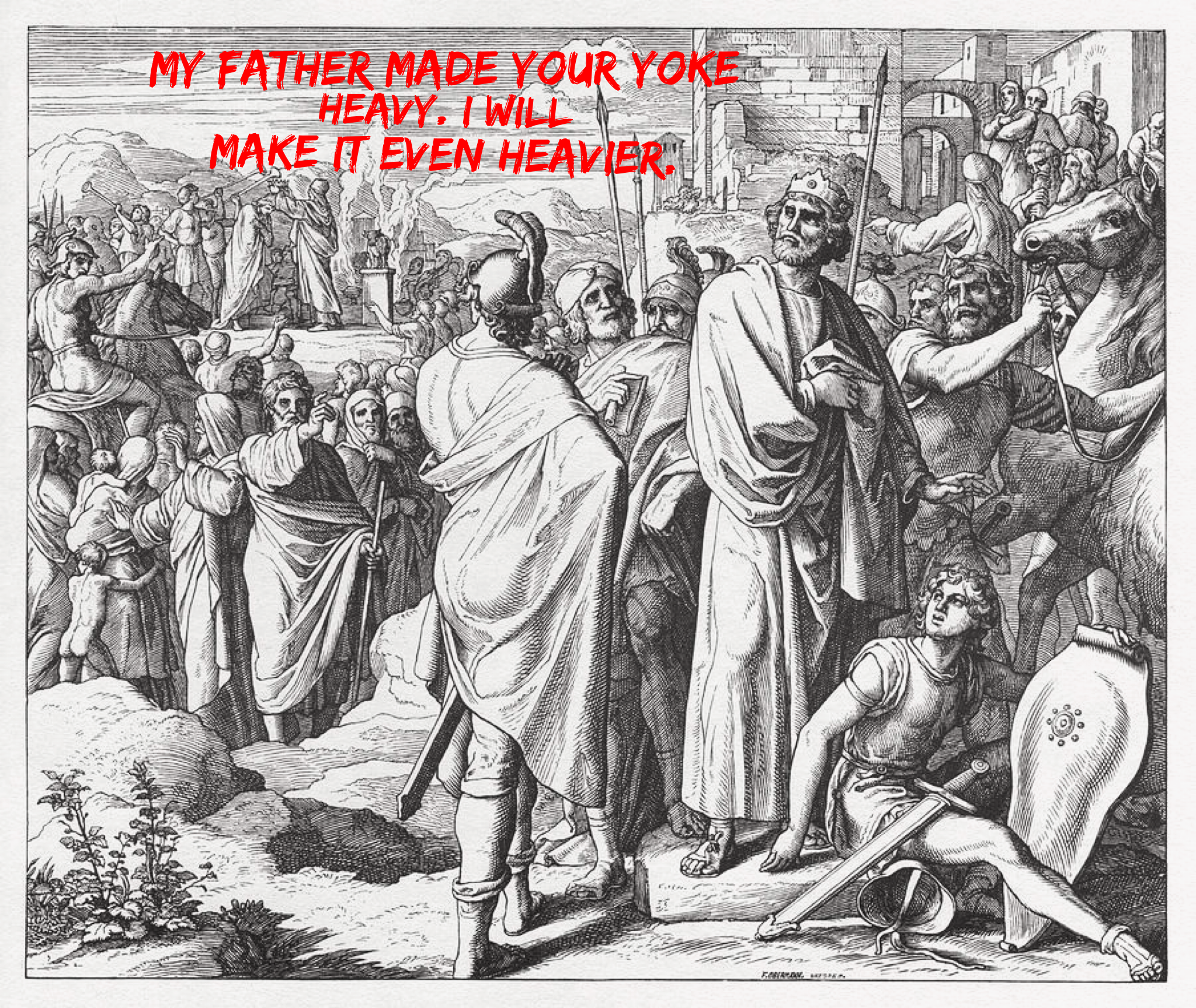
The young men who had grown up with him replied, “These people have said to you, ‘Your father put a heavy yoke on us, but make our yoke lighter.’ Now tell them, ‘My little finger is thicker than my father’s waist. My father laid on you a heavy yoke; I will make it even heavier. My father scourged you with whips; I will scourge you with scorpions.’”

Three days later Jeroboam and all the people returned to Rehoboam, as the king had said, “Come back to me in three days.” The king answered the people harshly. Rejecting the advice given him by the elders, he followed the advice of the young men and said, “My father made your yoke heavy; I will make it even heavier. My father scourged you with whips; I will scourge you with scorpions.” So the king did not listen to the people, for this turn of events was from the Lord, to fulfill the word the Lord had spoken to Jeroboam son of Nebat through Ahijah the Shilonite. 

When all Israel saw that the king refused to listen to them, they answered the king:

 “What share do we have in David,
what part in Jesse’s son?
To your tents, Israel!
Look after your own house, David!”
 

So the Israelites went home. But as for the Israelites who were living in the towns of Judah, Rehoboam still ruled over them.

_______________

Then Jeroboam fortified Shechem in the hill country of Ephraim and lived there. From there he went out and built up Peniel.

Jeroboam thought to himself, “The kingdom will now likely revert to the house of David. If these people go up to offer sacrifices at the temple of the Lord in Jerusalem, they will again give their allegiance to their lord, Rehoboam king of Judah. They will kill me and return to King Rehoboam.”

After seeking advice, the king made two golden calves. He said to the people, “It is too much for you to go up to Jerusalem. Here are your gods, Israel, who brought you up out of Egypt.” One he set up in Bethel, and the other in Dan.

Reflection

I was a big fan of the show Game of Thrones while it had its run on HBO. I love the genre of fantasy, and if you throw in some dragons, I am definitely a fan. I had been a fan of the book series long before it became a TV show as well. What made me such a fan of the books and the show, however, was not that it was just another epic fantasy series – what made me a fan was the character development and its nitty-gritty realpolitik. The series did not shy away from playing out the often-horrifying consequences of a Machiavellian politics – a politics not based upon any kind of moral ideal or social good, but based upon pragmatically amassing and asserting power.

Today’s text reads a little bit like a scene from Game of Thrones. In it, we see how the divided monarchy arose, barely one generation after King David. For a brief recap of what happens prior to this passage: when David dies, his son, Solomon, becomes the king. Solomon continued to amass and consolidate power through political alliances (often contracted through marriage – Solomon had hundreds of wives and concubines), through trade, and through major construction projects, including the Temple. Solomon was simultaneously seen as being both wise, but also as a one who was easily swayed and distracted by foreign gods.

When King Solomon dies, his son, Rehoboam succeeds him. Rehoboam, who has grown up wealthy and in a place of power, now wants to assert his power in his own right. The seeds of discontent have long been sowing in Solomon’s kingdom, and now they are brought to fruition. Jeroboam, who had previously served Solomon, but had deserted him and fled to Egypt, harboring a desire to become king over the ten northern kingdoms of Israel, at least in part because he saw Solomon’s sin of abandoning God to worship foreign gods. Once Solomon is dead, Jeroboam returns from Egypt to confront Rehoboam. Jeroboam gives Rehoboam a chance – if he will lighten the yoke placed upon the ten northern tribes of Israel, they will not rebel and they will serve Rehoboam.

Rehoboam sends Jeroboam away so he can consult with the elders from his father’s day. They advise him to lighten the yoke for the sake of peace in the kingdom. But Rehoboam is not satisfied with this advice. So instead, he consults his friends, who advise him not only to not lighten the yoke, but to make it heavier – to assert his dominance – to show them who’s boss. So this is what Rehoboam foolishly does.

And with that, the final nail is hammered into the coffin of the united monarchy. Jeroboam heads north where he is crowned as king of the ten northern tribes of Israel, while Rehoboam remains king over only the two southern tribes. Never again will the twelve tribes be united. Rehoboam continues to control Jerusalem and worship in the Temple, while Jeroboam sets up two sites for worship up north so those who belong to the northern kingdom do not have to travel down to Jerusalem to worship, thereby avoiding the temptation to worship the foreign gods that Solomon under his laxity had allowed to become a part of society.

Phew. Quite the history lesson, but perhaps also a theology lesson. Remember, that just a few generations prior to this moment, Israel had not had a king. It was not God’s desire that Israel have one. And yet, Israel demanded that God give them a king to be like the other nations. God warned them that it would not be good for them. They demanded anyway. What we see just a few short generations later is what happens when a people put their trust and hope in an earthly ruler. We see what happens to those who are put in positions of worldly power. It becomes a big old mess – full of corruption, entitlement, and power games.

Is this really what God desires for God’s people? Now take a few moments to think about our reality today. Is this really what God desires for God’s people?

Ponder

o   What words, phrases, or images from the text speak to you? What thoughts or feelings do they evoke?
o   How does this story speak to you today? What warnings or challenges might you take away from this text?
o   Who do you know who currently suffers under a heavy yoke?

Challenge

We are in the thick of gearing up for election season in our country. We probably each have a political party or stance that we tend to default to. It can be incredibly difficult to see the bigger picture or to see the way faith calls us beyond political party or candidate. Take some time today to pray, asking God to show you a third way of being in the world, apart from our embedded two-party system.

and/or 

Jeroboam asks Rehoboam to lighten the yoke of the people. Consider someone you know who would be considered to be living on the margins in our society – someone living below the poverty line, an immigrant, a person of color, a child who is currently in the foster system, etc. What can you do to lighten their load? Is there a task you can help them accomplish? Is there legislation you can lobby for? Do they have a story you can amplify?

Prayer

Lord Jesus Christ, I know that you are the one true King. You are the one true Savior. Help me to put my trust in you, and not in any other systems or powers or rulers. Help me to see those who suffer under a heavy yoke, and to take action to lighten that yoke as a builder of your kingdom. In Jesus’ name I pray. Amen.

– Cindy+

The Reflectionary – Week of October 13, 2019

Text: 2 Samuel 5:1-5; 6:1-5

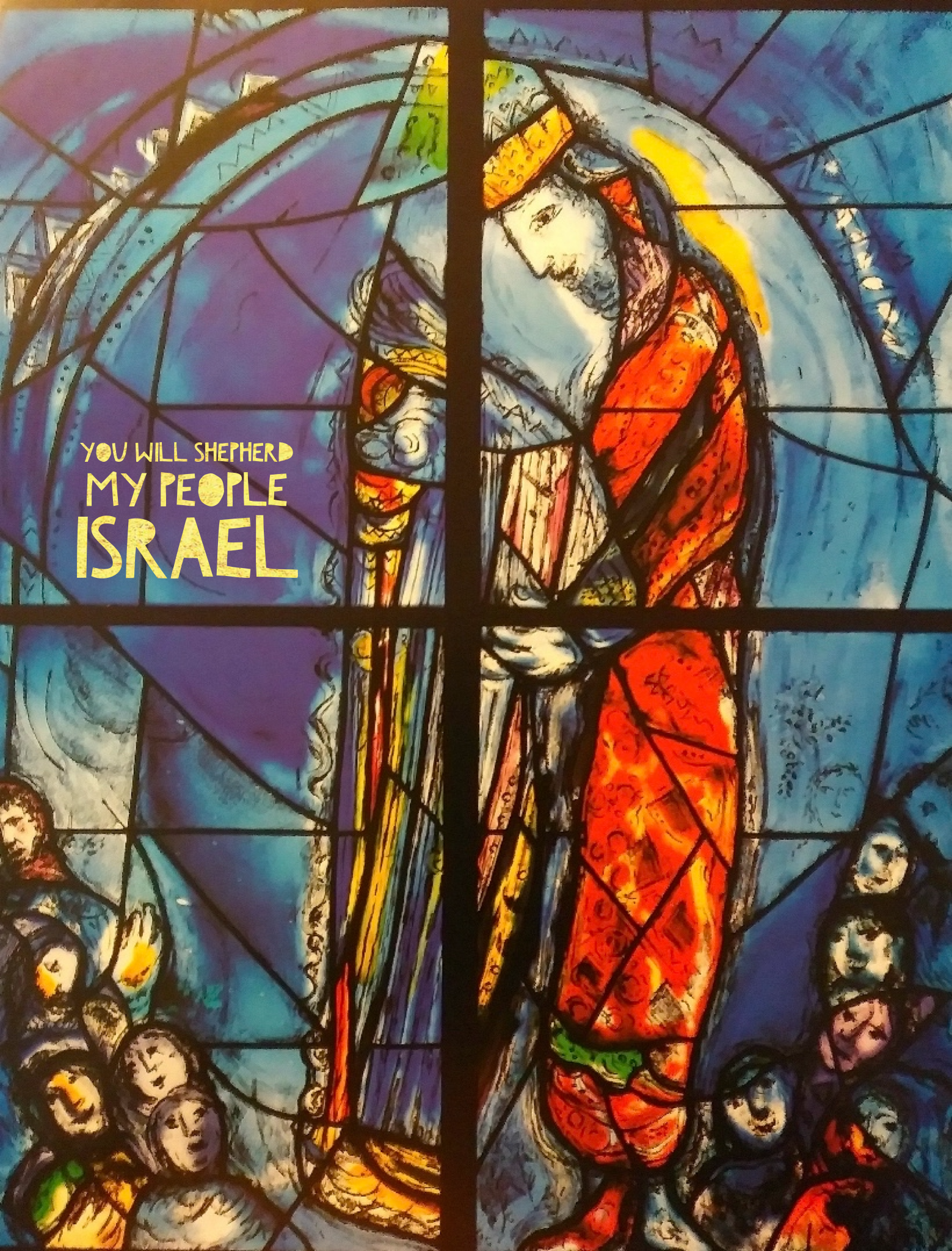
All the tribes of Israel came to David at Hebron and said, “We are your own flesh and blood. In the past, while Saul was king over us, you were the one who led Israel on their military campaigns. And the Lord said to you, ‘You will shepherd my people Israel, and you will become their ruler.’” 

When all the elders of Israel had come to King David at Hebron, the king made a covenant with them at Hebron before the Lord, and they anointed David king over Israel.

David was thirty years old when he became king, and he reigned forty years. In Hebron he reigned over Judah seven years and six months, and in Jerusalem he reigned over all Israel and Judah thirty-three years.

_______________

David again brought together all the able young men of Israel—thirty thousand. He and all his men went to Baalah in Judah to bring up from there the ark of God, which is called by the Name, the name of the Lord Almighty, who is enthroned between the cherubim on the ark. They set the ark of God on a new cart and brought it from the house of Abinadab, which was on the hill. Uzzah and Ahio, sons of Abinadab, were guiding the new cart with the ark of God on it, and Ahio was walking in front of it. David and all Israel were celebrating with all their might before the Lord, with castanets, harps, lyres, timbrels, sistrums and cymbals.

Reflection

These short passages are snapshots of King David’s life, marking two significant moments – when he became King over all of Israel, and when he brought the Ark of the Covenant into Jerusalem to give it a permanent resting place. David, as king, certainly did much for the people of Israel, in the name of God. David, of course, is seen as the greatest king of Israel. It is significant that Jesus comes from the line of David. He’s a pretty big deal.

We know, however, that David was also a flawed human being who at times, made absolutely terrible decisions (ie. taking Bathsheba for himself and having her husband killed). How could a king who is elevated to the extent that David is also do something so vile? We often hear of David as a man after God’s own heart. At times, that may, in fact be true. But in other moments, David’s heart is anything but. So what do we do with these conflicting ideas about David? Is he a great king, or a sinner of the worst kind? Is he generous and faithful, or a murderous and selfish lecher?

It is tempting to want to place David in one category or the other, writing the other off. But when we truly pause to think about who David was, what we actually see is ourselves. We, like David, have moments where our hearts are like God’s own heart – where we are merciful, where we are loving, where we are seeking justice. But then, there are other moments, where we are not bearing the heart of God. There are moments where we take what we want, when we want it, no matter who it hurts. There are moments where we act with hatred, or sometimes even violence.

Not one of us is totally good. Not one of us is totally evil. In our polarized world, it is a great temptation to write people off as one or the other. David did great things for Israel, to be sure. He worshipped God, and gave the Ark of the Covenant a permanent home. He enabled to people of Israel to find security and to flourish for a time. When David kept the kingship of God at the forefront of his life, he lived as a man after God’s own heart. It was when he became focused on his own power and desires that he strayed.

The same is true for us. When we recognize the kingship of God in our lives, above all powers, above all governments, above all nations, above the desires of self, then our hearts are able to be in alignment with God’s. But when we become focused on other powers above God’s reign, then our hearts and our desires become distorted. You may recall when Israel first began asking for a king to rule over them, the prophet Samuel reminded them that they would regret it – that God was their king, and that if they wanted to have kings like the other nations, then they would, in fact, become like other nations where the rich oppress to poor, where the rulers consolidate power and their subjects cry out for relief. Eventually, this did happen.

There is no king but Christ. There is no one who is above him. Worship of the wrong things (idolatry) is the continual struggle of God’s people from the very beginning, up until today. Consider how you may personally be experiencing this struggle.

Ponder

o   What words, phrases, or images from the text speak to you? What thoughts or feelings do they evoke?
o   In what areas of your life might you be struggling to allow Christ to reign?
o   In whom do you struggle to see any good? What do you think is preventing that ability?

Challenge

Think of that person in whom you struggle to see any good. Pray for them, and pray that you might be able to see glimpses of goodness in them.

and/or

What are the most important things in your life? How might they be in alignment with Christ’s kingship, or how might they be in conflict? Take some time to reflect and to journal about your current priorities.

Prayer

Lord Jesus Christ, you are the one true King. You are greater than any power, than any leader, than any nation. Help me to live as a citizen of your kingdom, and to be able to discern what that looks like. Give me a heart that is like yours – one that loves like yours. Allow me to catch glimpses of your image in others, even in those whom I would deem my enemy. At the same time, allow me to see the sin and the evil that exists within my own heart. Lead me, transform me, make me new. In Jesus’ name I pray. Amen.

-Cindy+