The Reflectionary – Week of October 20, 2019

Text: 1 Kings 12:1-17, 25-29

Rehoboam went to Shechem, for all Israel had gone there to make him king. When Jeroboam son of Nebat heard this (he was still in Egypt, where he had fled from King Solomon), he returned from Egypt. So they sent for Jeroboam, and he and the whole assembly of Israel went to Rehoboam and said to him: “Your father put a heavy yoke on us, but now lighten the harsh labor and the heavy yoke he put on us, and we will serve you.”

Rehoboam answered, “Go away for three days and then come back to me.” So the people went away.

Then King Rehoboam consulted the elders who had served his father Solomon during his lifetime. “How would you advise me to answer these people?” he asked.

They replied, “If today you will be a servant to these people and serve them and give them a favorable answer, they will always be your servants.” 

But Rehoboam rejected the advice the elders gave him and consulted the young men who had grown up with him and were serving him. He asked them, “What is your advice? How should we answer these people who say to me, ‘Lighten the yoke your father put on us’?”

The young men who had grown up with him replied, “These people have said to you, ‘Your father put a heavy yoke on us, but make our yoke lighter.’ Now tell them, ‘My little finger is thicker than my father’s waist. My father laid on you a heavy yoke; I will make it even heavier. My father scourged you with whips; I will scourge you with scorpions.’”
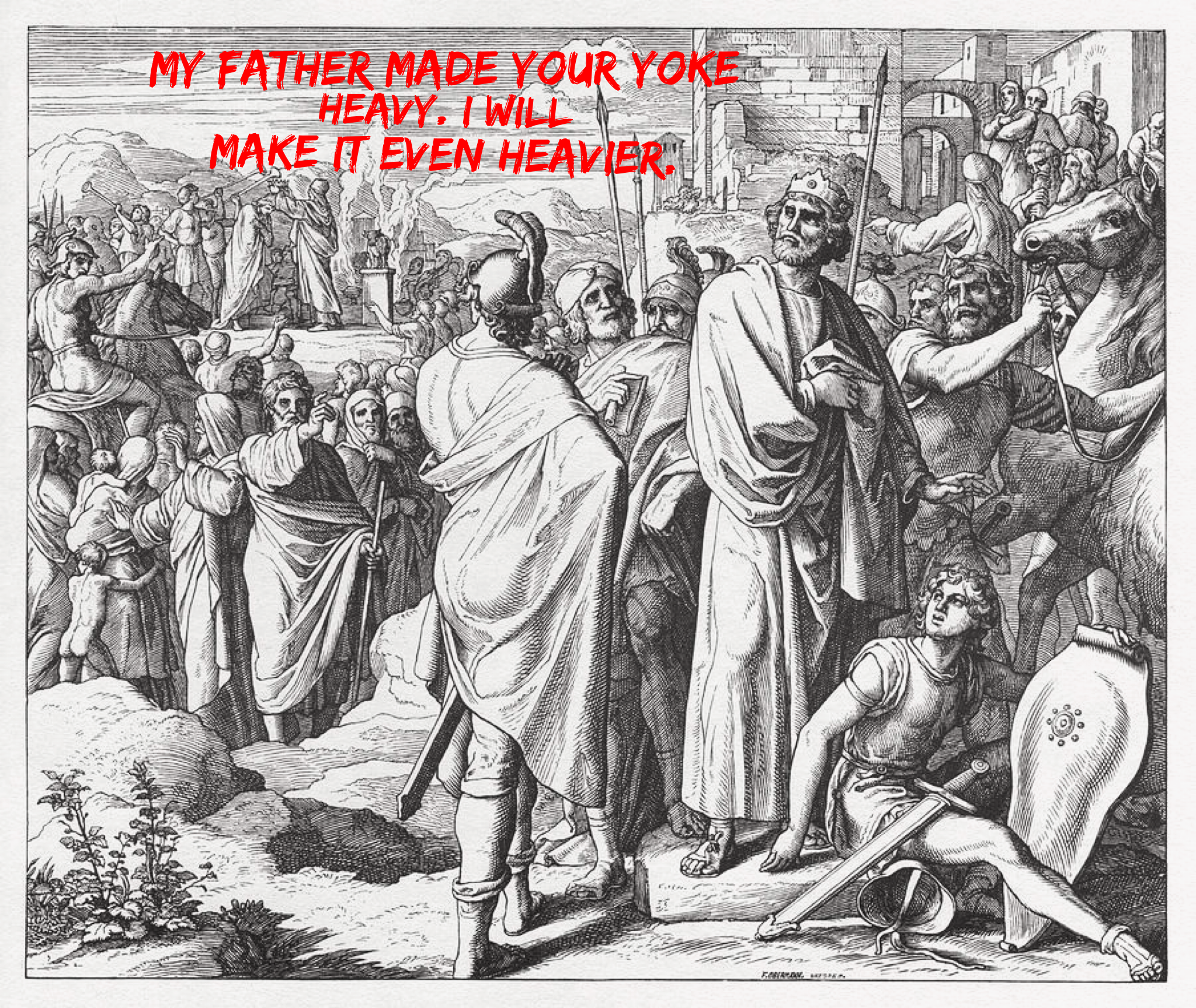
Three days later Jeroboam and all the people returned to Rehoboam, as the king had said, “Come back to me in three days.” The king answered the people harshly. Rejecting the advice given him by the elders, he followed the advice of the young men and said, “My father made your yoke heavy; I will make it even heavier. My father scourged you with whips; I will scourge you with scorpions.” So the king did not listen to the people, for this turn of events was from the Lord, to fulfill the word the Lord had spoken to Jeroboam son of Nebat through Ahijah the Shilonite. 

When all Israel saw that the king refused to listen to them, they answered the king:

 “What share do we have in David,
what part in Jesse’s son?
To your tents, Israel!
Look after your own house, David!”
 

So the Israelites went home. But as for the Israelites who were living in the towns of Judah, Rehoboam still ruled over them.

_______________

Then Jeroboam fortified Shechem in the hill country of Ephraim and lived there. From there he went out and built up Peniel.

Jeroboam thought to himself, “The kingdom will now likely revert to the house of David. If these people go up to offer sacrifices at the temple of the Lord in Jerusalem, they will again give their allegiance to their lord, Rehoboam king of Judah. They will kill me and return to King Rehoboam.”

After seeking advice, the king made two golden calves. He said to the people, “It is too much for you to go up to Jerusalem. Here are your gods, Israel, who brought you up out of Egypt.” One he set up in Bethel, and the other in Dan.

Reflection

I was a big fan of the show Game of Thrones while it had its run on HBO. I love the genre of fantasy, and if you throw in some dragons, I am definitely a fan. I had been a fan of the book series long before it became a TV show as well. What made me such a fan of the books and the show, however, was not that it was just another epic fantasy series – what made me a fan was the character development and its nitty-gritty realpolitik. The series did not shy away from playing out the often-horrifying consequences of a Machiavellian politics – a politics not based upon any kind of moral ideal or social good, but based upon pragmatically amassing and asserting power.

Today’s text reads a little bit like a scene from Game of Thrones. In it, we see how the divided monarchy arose, barely one generation after King David. For a brief recap of what happens prior to this passage: when David dies, his son, Solomon, becomes the king. Solomon continued to amass and consolidate power through political alliances (often contracted through marriage – Solomon had hundreds of wives and concubines), through trade, and through major construction projects, including the Temple. Solomon was simultaneously seen as being both wise, but also as a one who was easily swayed and distracted by foreign gods.

When King Solomon dies, his son, Rehoboam succeeds him. Rehoboam, who has grown up wealthy and in a place of power, now wants to assert his power in his own right. The seeds of discontent have long been sowing in Solomon’s kingdom, and now they are brought to fruition. Jeroboam, who had previously served Solomon, but had deserted him and fled to Egypt, harboring a desire to become king over the ten northern kingdoms of Israel, at least in part because he saw Solomon’s sin of abandoning God to worship foreign gods. Once Solomon is dead, Jeroboam returns from Egypt to confront Rehoboam. Jeroboam gives Rehoboam a chance – if he will lighten the yoke placed upon the ten northern tribes of Israel, they will not rebel and they will serve Rehoboam.

Rehoboam sends Jeroboam away so he can consult with the elders from his father’s day. They advise him to lighten the yoke for the sake of peace in the kingdom. But Rehoboam is not satisfied with this advice. So instead, he consults his friends, who advise him not only to not lighten the yoke, but to make it heavier – to assert his dominance – to show them who’s boss. So this is what Rehoboam foolishly does.

And with that, the final nail is hammered into the coffin of the united monarchy. Jeroboam heads north where he is crowned as king of the ten northern tribes of Israel, while Rehoboam remains king over only the two southern tribes. Never again will the twelve tribes be united. Rehoboam continues to control Jerusalem and worship in the Temple, while Jeroboam sets up two sites for worship up north so those who belong to the northern kingdom do not have to travel down to Jerusalem to worship, thereby avoiding the temptation to worship the foreign gods that Solomon under his laxity had allowed to become a part of society.

Phew. Quite the history lesson, but perhaps also a theology lesson. Remember, that just a few generations prior to this moment, Israel had not had a king. It was not God’s desire that Israel have one. And yet, Israel demanded that God give them a king to be like the other nations. God warned them that it would not be good for them. They demanded anyway. What we see just a few short generations later is what happens when a people put their trust and hope in an earthly ruler. We see what happens to those who are put in positions of worldly power. It becomes a big old mess – full of corruption, entitlement, and power games.

Is this really what God desires for God’s people? Now take a few moments to think about our reality today. Is this really what God desires for God’s people?

Ponder

o   What words, phrases, or images from the text speak to you? What thoughts or feelings do they evoke?
o   How does this story speak to you today? What warnings or challenges might you take away from this text?
o   Who do you know who currently suffers under a heavy yoke?

Challenge

We are in the thick of gearing up for election season in our country. We probably each have a political party or stance that we tend to default to. It can be incredibly difficult to see the bigger picture or to see the way faith calls us beyond political party or candidate. Take some time today to pray, asking God to show you a third way of being in the world, apart from our embedded two-party system.

and/or 

Jeroboam asks Rehoboam to lighten the yoke of the people. Consider someone you know who would be considered to be living on the margins in our society – someone living below the poverty line, an immigrant, a person of color, a child who is currently in the foster system, etc. What can you do to lighten their load? Is there a task you can help them accomplish? Is there legislation you can lobby for? Do they have a story you can amplify?

Prayer

Lord Jesus Christ, I know that you are the one true King. You are the one true Savior. Help me to put my trust in you, and not in any other systems or powers or rulers. Help me to see those who suffer under a heavy yoke, and to take action to lighten that yoke as a builder of your kingdom. In Jesus’ name I pray. Amen.

– Cindy+
The Reflectionary – Week of October 13, 2019

Text: 2 Samuel 5:1-5; 6:1-5

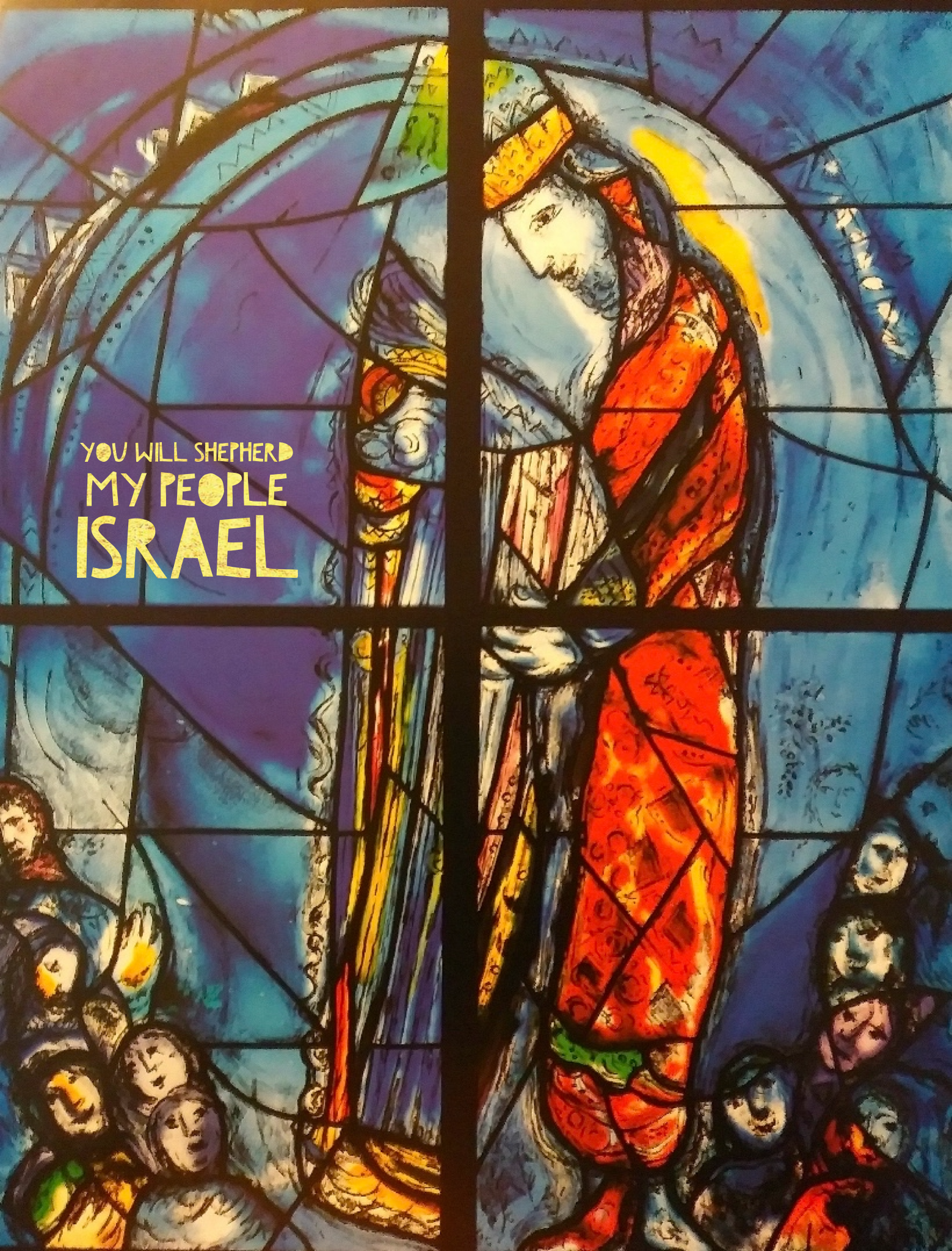
All the tribes of Israel came to David at Hebron and said, “We are your own flesh and blood. In the past, while Saul was king over us, you were the one who led Israel on their military campaigns. And the Lord said to you, ‘You will shepherd my people Israel, and you will become their ruler.’” 

When all the elders of Israel had come to King David at Hebron, the king made a covenant with them at Hebron before the Lord, and they anointed David king over Israel.

David was thirty years old when he became king, and he reigned forty years. In Hebron he reigned over Judah seven years and six months, and in Jerusalem he reigned over all Israel and Judah thirty-three years.

_______________

David again brought together all the able young men of Israel—thirty thousand. He and all his men went to Baalah in Judah to bring up from there the ark of God, which is called by the Name, the name of the Lord Almighty, who is enthroned between the cherubim on the ark. They set the ark of God on a new cart and brought it from the house of Abinadab, which was on the hill. Uzzah and Ahio, sons of Abinadab, were guiding the new cart with the ark of God on it, and Ahio was walking in front of it. David and all Israel were celebrating with all their might before the Lord, with castanets, harps, lyres, timbrels, sistrums and cymbals.

Reflection

These short passages are snapshots of King David’s life, marking two significant moments – when he became King over all of Israel, and when he brought the Ark of the Covenant into Jerusalem to give it a permanent resting place. David, as king, certainly did much for the people of Israel, in the name of God. David, of course, is seen as the greatest king of Israel. It is significant that Jesus comes from the line of David. He’s a pretty big deal.

We know, however, that David was also a flawed human being who at times, made absolutely terrible decisions (ie. taking Bathsheba for himself and having her husband killed). How could a king who is elevated to the extent that David is also do something so vile? We often hear of David as a man after God’s own heart. At times, that may, in fact be true. But in other moments, David’s heart is anything but. So what do we do with these conflicting ideas about David? Is he a great king, or a sinner of the worst kind? Is he generous and faithful, or a murderous and selfish lecher?

It is tempting to want to place David in one category or the other, writing the other off. But when we truly pause to think about who David was, what we actually see is ourselves. We, like David, have moments where our hearts are like God’s own heart – where we are merciful, where we are loving, where we are seeking justice. But then, there are other moments, where we are not bearing the heart of God. There are moments where we take what we want, when we want it, no matter who it hurts. There are moments where we act with hatred, or sometimes even violence.

Not one of us is totally good. Not one of us is totally evil. In our polarized world, it is a great temptation to write people off as one or the other. David did great things for Israel, to be sure. He worshipped God, and gave the Ark of the Covenant a permanent home. He enabled to people of Israel to find security and to flourish for a time. When David kept the kingship of God at the forefront of his life, he lived as a man after God’s own heart. It was when he became focused on his own power and desires that he strayed.

The same is true for us. When we recognize the kingship of God in our lives, above all powers, above all governments, above all nations, above the desires of self, then our hearts are able to be in alignment with God’s. But when we become focused on other powers above God’s reign, then our hearts and our desires become distorted. You may recall when Israel first began asking for a king to rule over them, the prophet Samuel reminded them that they would regret it – that God was their king, and that if they wanted to have kings like the other nations, then they would, in fact, become like other nations where the rich oppress to poor, where the rulers consolidate power and their subjects cry out for relief. Eventually, this did happen.

There is no king but Christ. There is no one who is above him. Worship of the wrong things (idolatry) is the continual struggle of God’s people from the very beginning, up until today. Consider how you may personally be experiencing this struggle.

Ponder

o   What words, phrases, or images from the text speak to you? What thoughts or feelings do they evoke?
o   In what areas of your life might you be struggling to allow Christ to reign?
o   In whom do you struggle to see any good? What do you think is preventing that ability?

Challenge

Think of that person in whom you struggle to see any good. Pray for them, and pray that you might be able to see glimpses of goodness in them.

and/or

What are the most important things in your life? How might they be in alignment with Christ’s kingship, or how might they be in conflict? Take some time to reflect and to journal about your current priorities.

Prayer

Lord Jesus Christ, you are the one true King. You are greater than any power, than any leader, than any nation. Help me to live as a citizen of your kingdom, and to be able to discern what that looks like. Give me a heart that is like yours – one that loves like yours. Allow me to catch glimpses of your image in others, even in those whom I would deem my enemy. At the same time, allow me to see the sin and the evil that exists within my own heart. Lead me, transform me, make me new. In Jesus’ name I pray. Amen.

-Cindy+

The Reflectionary – Week of September 22, 2019

Text: Jeremiah 18:1-6

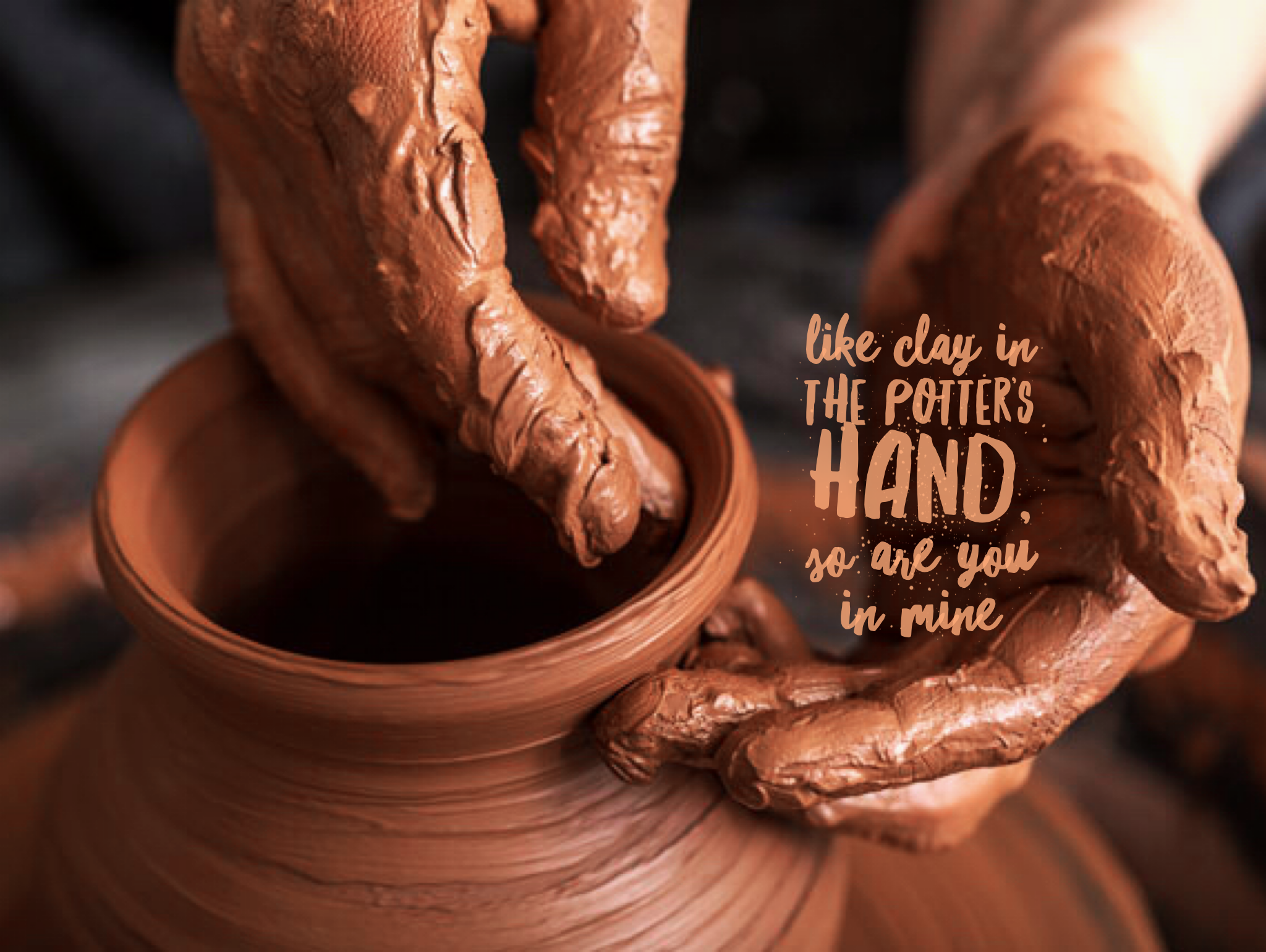
This is the word that came to Jeremiah from the Lord: “Go down to the potter’s house, and there I will give you my message.” So I went down to the potter’s house, and I saw him working at the wheel. But the pot he was shaping from the clay was marred in his hands; so the potter formed it into another pot, shaping it as seemed best to him. 

Then the word of the Lord came to me. He said, “Can I not do with you, Israel, as this potter does?” declares the Lord. “Like clay in the hand of the potter, so are you in my hand, Israel.”

Reflection

A few years ago, I decided that I wanted to learn how to throw pottery, so for Christmas that year, I was gifted with the opportunity to take a six-week pottery class at a local studio. It quickly turned into an enjoyable hobby as I ventured out from making simple bowls, plates, and mugs to things like Communion sets, teapots, and casserole dishes. There is something quite pleasant, even meditative, about running your hands over the clay as it spins on the wheel.

But in those first few weeks of learning, one of the things that caught me by surprise was how much force I needed to use to get the clay centered on the wheel. You can’t begin shaping your vessel until the clay is centered. And in order to get it centered, you have to use lots of pressure. You have to use the strength of your whole body. You have to have a steady hand.

Sometimes, it was easy for me to get a lump of clay centered. But sometimes it was hard. Sometimes it took me longer, for reasons unknown to me. Maybe it was just me, maybe it was the clay. Some days were just that way.

In this segment of Jeremiah, the prophet goes down to the potter’s house, who is at work on his wheel, creating vessels of all kinds. As Jeremiah watches, he sees the potter push down and reshape a pot he is working on. Potters do this all the time. Sometimes a vessel just doesn’t get shaped the way the potter intends. In my pottery class, we would often laugh together that the clay has a mind of its own some days. I’ve had mugs that have decided they actually wanted to be bowls, bowls that have become plates, and sometimes even teapots that decided they are best turned back into a slab of clay to be reused at another time. As I do not have the skill of a master potter, I would simply let the clay become whatever it wanted to be.

In this passage, God calls Israel clay in his hands. Israel can be re-shaped, re-fashioned. The story of Israel, in fact, is the story of a shaping of a people – a people called by God to be a part of a covenant. It is a story of a continual re-shaping, as the clay attempts to become something other than the Master Potter’s desired intentions. God, the potter, continually re-works the vessel. But notice that the potter never throws the lump of clay away. He doesn’t toss it aside in anger or frustration. He just keeps on re-working it, helping it take the desired shape.

There are at least two things I hope you can hear clearly in this text.

First – this is a story about the people of Israel – the people of the covenant. That covenant is never revoked by God. The Church does not replace or supersede the people of Israel. Our Jewish brothers and sisters continue to be a people of the covenant, clay in the potter’s hands.

Second – this is also a story about us – the people of the new covenant through Christ. God continually shapes us. God never tosses us aside in anger or frustration. He just keeps tossing water on us, and with the gentle pressure of his hands, he keeps re-working us, helping us to take the desired shape – as individuals and as a community.

Being a potter is a messy business. You get covered in clay, in water. They clay gets under your nails and all over your clothes. It can stain your hands. God is our Master Potter. He gets down in our mess and continually reshapes us – sometimes patiently and gently, sometimes more forcefully, but always with care and skill. The Master Potter never throws us aside or declares us to be useless lumps of clay (which I have, in fact, declared of some of my own particular failed pottery attempts).

Like clay in the potter’s hands, so are we in God’s hands.

Ponder

o  What words, phrases, or images from the text speak to you? What thoughts or feelings do they evoke?
o  Where in your life do you sense God working right now?
o  Where have you resisted the work of the Master Potter in your life? I wonder what might be at the root of that resistance?

Challenge

Consider an area of your life that God may be trying to transform. What can you do to become more malleable clay? What habits or disciplines might you need to take on? What might you need to let go of? Spend time journaling, praying, or talking to God about these things, asking for direction.

and/or

Find an opportunity to create, whether it is playing with clay, or play-doh, whether it is painting, crocheting, working in the garden, or any other number of things. Imagine God creating or working in you as you yourself create.

Prayer

God, you are the Master Potter, and I am clay in your hands. Mold me, make me, move me. Through the waters of my baptism, make me malleable. Through the sometimes dizzying spinning of life’s wheel, shape me. Keep on working on me until all the lumps and bumps are smoothed away. Turn me into a vessel that carries your love and grace to others. Fill me, use me. In Jesus’ name, I pray. Amen.

-Cindy+